Showing posts with label promote school nurses. Show all posts

Sunday, July 21, 2024

Scope & Standards for School Nursing Practice

School Nursing: Scope and Standards of Practice

+ This post contains affiliate links. +

This blog post discusses the scope and standards of practice for school nursing. Explores NANSs definitions and overview of their new book.

Hopefully Helpful School Nurse Tip: Familiarize yourself with the NASN Scope and Standards of Practice to clearly understand your role, use consistent terminology, and ensure you meet professional expectations in delivering high-quality school health services.

Even before checking out the NASN Scope and Standards of Practice for School Nursing, I recommend reviewing your job description and becoming familiar with your state nursing practice act. Understanding these foundational documents is crucial to navigating your role effectively.

Then, I suggest checking out the NASN Scope and Standards of Practice. This guide helps clarify your role, introduces essential terminology, and outlines what’s expected as you provide quality school health services. Read on for an overview of the book!

Understanding the NASN Scope and Standards of Practice for School Nursing

The National Association of School Nurses (NASN) plays a pivotal role in defining the scope and standards of practice for school nursing. These guidelines are essential for shaping the professional landscape of school nursing, detailing the who, what, where, when, how, and why of this specialized field.

Scope of Practice:
The scope of practice in school nursing outlines the parameters within which school nurses operate. I purchased the latest edition when I renewed my NASN membership and you can too OR you can search for the latest edition of the book here. It answers key questions:
Who: The school nurses who provide healthcare services within educational settings.
What: The nature of services and care provided, from health assessments to emergency response.
Where: The school and community settings where these services are delivered.
When: The timing and circumstances under which school nursing interventions are appropriate.
How: The methodologies and procedures used in delivering school health services.
Why: The underlying rationale and importance of school nursing in promoting student health and academic success.
Standards of Practice:
The NASN has established 18 standards that set the professional expectations for behavior and practice in school nursing. These standards are designed to guide school nurses in delivering high-quality care and maintaining professional integrity. They cover areas such as ethical practice, continuing education, and collaboration with other healthcare professionals and educators.

Why This Matters:
The publication of these standards and scope not only highlights the specialty of school nursing but also reinforces the professional expectations that underpin the practice. By adhering to these guidelines, school nurses can ensure they provide comprehensive and effective care to their students.

How to Utilize the NASN Publication:
For school nurses looking to deepen their understanding and refine their practice, the NASN publication is an invaluable resource. Here are a few ways to make the most of it:
  1. Define School Nursing: Use the scope outlined in the publication to clearly define what school nursing entails. This can help in explaining your role to colleagues, parents, and administrators.
  2. Review Common Terminology: Familiarize yourself with the terminology used throughout the book and in the glossary. This will ensure you are using consistent language and can communicate effectively with others in the field.
  3. Guide Your Practice: Regularly refer to the 18 standards to ensure your practice aligns with professional expectations. This can help in maintaining a high standard of care and staying updated with best practices.
By exploring the NASN Scope and Standards of Practice for School Nursing, you can enhance your professional knowledge, improve your practice, and better serve your school community. The NASN's commitment to defining and upholding these standards underscores the vital role school nurses play in supporting student health and academic achievement.

I purchased the latest edition when I renewed my NASN membership and you can too OR you can search for the latest edition of the book here.


 Check out these other popular DOASN blog posts & product links.


Thursday, July 6, 2023

New School Nurse Advice

Advice For New School Nurses

+ This post contains affiliate links. +


Hopefully Helpful School Nurse Tip: A new career as a school nurse can be overwhelming, but it can also be an exciting opportunity for growth and fulfillment. I'll post links below to relevant DOASN blog posts that will help you get started on your journey. Remember, starting a new career takes time and effort, but with dedication and perseverance, you can find a fulfilling and rewarding path.


Subscribe to the new school nurse email HERE, then check out the online, anytime 1 hour CE course created just for new school nurses HERE!


Welcome to the world of school nursing!

Hello New School Nurses!

Hi there! Welcome to your new career as a school nurse. This job is super important & involves a lot of different duties! You'll be helping to keep students, teachers, and everyone at school healthy & safe. Remember, you’ve got the skills and knowledge to handle whatever comes your way; you just might need a  little extra education and you've come to the right place for that! Again, welcome to school nursing! I hope you have a great and rewarding career.

        Sincerely, 

        Elisabeth AKA The School Nurse 

FAQs FOR NEW SCHOOL NURSES

Advocacy & Support

Advocacy and support for school nurses are crucial for ensuring the health and well-being of students and school staff. School nurses play a critical role in promoting health education, providing preventative care, and managing chronic conditions. By advocating for school nurses, we can ensure that schools have the resources and support necessary to provide quality healthcare services to students.

Supporting school nurses can lead to improved academic outcomes as healthy students are better able to focus and learn. Therefore, it is essential to prioritize advocacy and support for school nurses to maintain a healthy school environment and promote student success.

RESOURCES


Mentorship & Networking

Networking and mentoring are both beneficial for school nurses, but they serve different purposes. 

Networking involves building relationships with other professionals in the same field or industry, which can lead to new job opportunities, sharing of resources and ideas, and expanding one's knowledge and skills. On the other hand, mentoring involves a more personal relationship between a more experienced school nurse and a less experienced school nurse, where the mentor provides guidance, support, and advice on career development and professional growth. 

While networking can be done with multiple people, mentoring typically involves a one-on-one relationship. Finding a mentor is important for new school nurses.  A mentor can offer advice on how to handle difficult situations, share best practices, and provide insight into the unique challenges of working in a school setting. 

In addition, having a mentor can help new school nurses build confidence and establish a professional network. Overall, finding a mentor can be a valuable resource for new school nurses as they navigate their role and responsibilities in the school healthcare setting.  

School nurses can find networking & mentorship opportunities via online avenues. Check out a few online resources listed below.


RESOURCES
Google Search Results "School Nurse Mentor"
Google Search Results "School Nurse Networking"


Duties & Responsibilities
School nurses have a variety of duties and responsibilities. Not only are they responsible for managing student health records, administering medications and treatments, and providing first aid and emergency care; they also may be responsible for conducting health screenings, developing and implementing health education programs, and collaborating with other healthcare professionals to ensure the overall health and well-being of students. 

School nurses play a critical role in promoting a healthy school environment and supporting the academic success of students.  The duties and responsibilities of each school nurse should be defined with state practice guidelines and school district needs.


RESOURCES


Routines & Boundaries

Establishing a daily routine with clear boundaries (including taking a lunch break) can be essential for school nurses. Routines can help you manage your workload effectively, ensure that they have time for self-care, and prevent burnout. 

Remember, you are setting a healthy example for your students and staff too. Would you encourage them to skip lunch daily or eat while working?  If not, then you need to prioritize your lunch break too. Taking your lunch break can help you recharge, attend to their personal needs, and ultimately provide better care to students. It is important to prioritize self-care and establish healthy habits to maintain overall well-being and provide the best possible care to those in need.

RESOURCES

Organization & Decor

Having an organized school nurse's office is crucial for several reasons:
  1. It ensures that all necessary medical supplies and equipment are easily accessible and readily available when needed. This can be critical in emergency situations where time is of the essence. 
  2. An organized office helps to maintain a clean and sanitary environment, minimizing the risk of infections or the spread of illness. It can also help to streamline administrative tasks, such as record-keeping and inventory management, allowing nurses to spend more time providing care to patients. 
  3. An organized nurse's office is essential for providing efficient, effective, and high-quality healthcare services.
School nurses spend a lot of time at work, take the time to create a space that is functional and makes you feel good. An aesthetically pleasing office space is important for several reasons:
  1. It sets the tone; a visually appealing workspace can impress students & staff, helping to create a professional and trustworthy image for your school. 
  2. Creating a positive and comfortable work environment can lead to increased productivity and job satisfaction.
  3. A well-designed office space can also reflect the values and culture of your school and your professional values as well. 

RESOURCES
 

Funding & Budgets & Supplies

Public school budgets are the financial plans that outline how funds will be allocated to various school programs and services. The funding for school nurse staff is typically included in the overall budget and varies depending on factors such as the size of the school district, the number of schools, and the student population. Funding can come from a variety of sources, including federal and state grants, local property taxes, and fundraising efforts. 

School nurse staff play an important role in promoting student health and wellness, and it is essential that schools allocate adequate funding to ensure that students have access to quality healthcare services.  

One way to provide quality is to have the supplies you need & to know where (& how) to purchase those supplies. You'll want to find out what your school year budget is and what you are required to purchase from that budget & from where you can purchase items. 

The easiest way for me to get supplies is to place a purchase order with the assigned person at my school district through our Amazon Business account! This account offers no tax and quick (usually two day), free shipping! You can view all of my supply lists HERE.

OTHER RESOURCES


 Check out these other popular DOASN blog posts & product links.


Sunday, September 19, 2021

Supporting and Promoting School Nurses

Healthy Children Learn Better,

School Nurses Make It Happen!

~ this post contains affiliate links ~

Helpful School Nurse Tip: Nurses have been working in schools for over a century! And although there have been many changes since then, the goal remains the same. The goal is to keep children in school through health promotion, education, and disease prevention. Remember- Students must be healthy to be educated and educated to be healthy. 

What is school nursing?

School nursing as defined by the National Association of School Nurses (NASN) is “a specialized practice of nursing, protects and promotes student health, facilitates optimal development, and advances academic success. School nurses, grounded in ethical and evidence-based practice, are the leaders who bridge health care and education, provide care coordination, advocate for quality student-centered care, and collaborate to design systems that allow individuals and communities to develop their full potential.” (Adopted by the NASN Board of Directors February 2017) The vision is that “all students are healthy, safe, and ready to learn” and their mission is to “optimize student health and learning”. It is a big undertaking, but with adequate staff and a team collaboration it is possible. Keeping this definition, mission, and vision it is clear to see why school nurses are needed in schools!

Why are school nurses needed?

Healthy Children Learn Better, School Nurses Make It Happen


Most school nurses have heard the above phrase before and I'm not 100% certain who said it first, so it is difficult to give credit. However, it seems true, right? Healthy children learn better and school nurses make it happen. I bet you're not surprised that over 98% of US children attend school (National Center for Education Statistics, 2019). However, you might be surprised to know that 40% of those children have been diagnosed with a chronic health condition (CDC, 2019).  Having a school nurse on campus can help those children attend school safely while remaining in the least restrictive school environment.


Compilation of Some Common Physician Verified Student Health Diagnoses

This chart is just a partial list- Add diagnoses you have dealt with in the school setting in the comment section below. The severity of each health condition is specific to each child. So, the responsibilities and duties of school nurses changes from one semester to the next and one school year to another school year. Regardless, school nurses must be prepared to care for students with mild health conditions to severe, life threatening health conditions (not to mention health emergencies in the school setting too).

Attention Deficit Disorder

Allergies

Anxiety

Asthma

Bleeding Disorders

Brain Defects

Celiac Disease

Cerebral Palsy with Partial Limb Paralysis

Diabetes- Type 1

Gastrointestinal Issues

Gilbert’s Syndrome

Hurler Syndrome

Headaches/Migraines

Autoimmune Hepatitis

Hypothyroidism

Heart Conditions

Rheumatoid Arthritis

Ehlers-Danlos Syndrome

Scoliosis

Seizure Disorders

Vision Impairments-

partial and total blindness


How many nurses are employed by your school district?

How many students are at your school?  How many schools do you cover? 

These are very common questions among school nurses and the answers seem to vary greatly! Using the recommended ratio provided by NASN- is your school overstaffed, understaffed, or perfectly staffed?  Please use the comment section to leave your answer and let us know if you're surprised by your answer?  If you feel as though your school and/or school district is understaffed then come up with a plan of action on how you can promote school nursing positions and advocate for more nursing staff within the schools of your school district.  Keep in mind that the number of nurses needed could change from school year to school year depending on the required health needs of your students.


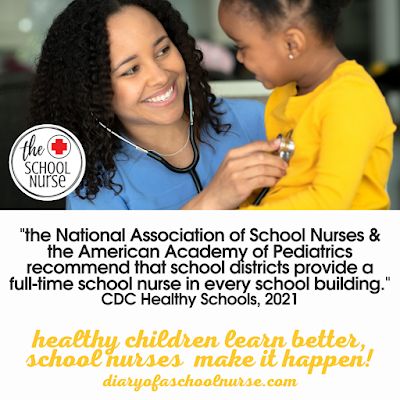
Having a full-time nurse in every school building is a recommendation by the National Association of School Nurses AND the American Academy of Pediatrics (link in the resource section below). School nurses are capable of caring for student health needs while at school. In addition, (when time allows) school nurses can: 
  • Become certified to screen vision and hearing 
  • Conduct drug testing for your high school athletic department
  • Teach coaches & other staff/students basic first aid and CPR skills
  • Support the monthly AED checks
  • Provide health education lessons and demonstrations in classrooms
  • Complete health reviews as part of the Special Education IEP team
  • Collaborate with community professionals to host school wide immunization clinics, physical exams, and dental exams and restorative dental treatment

Benefits of Hiring a Full Time School Nurse

There are countless benefits to hiring a school nurse for every school. Let's list 5 here that were pointed out by the CDC in their School Nurses Help Keep Students Healthy article:
  1. School Nurses can actually save a school district money!
  2. School Nurses may be the first health provider to identify a chronic health condition in a student.
  3. School Nurses can help students manage their chronic health conditions.
  4. School Nurses help protect the health and safety of both students and staff.
  5. School Nurses play an important role during public health crises.
Some people might find it hard to believe that hiring a school nurse could actually save their community money, but it's true. Wang et al (2014) utilized standard cost-benefit analysis methods to estimate the costs and benefits of an essential health services program compared with a scenario involving no school nursing services. They found for every dollar invested in full-time registered nurses, there was a gain of $2.20 for the society. This gain occurred because school nurses and the services they are able to provide offer a "benefit to schools, families, the health care system, and the community at large through increased student attendance, improved teacher and worker productivity, and reduced health care costs." Wang et al (2014)


PS- As you can see, the Wang et al study was completed in 2014- it would be very interested for someone to replicate this study for 2022 and compare the results! Who is looking for a research project?

PSS- Not touched on in this post is Medicaid Reimbursement for schools when nurses perform medication administration and other required and/or prescribed nursing services for students with IEPs who qualify for billing and reimbursement. I will save that detailed topic for it's very own blog post!


School Nurse Resources

CDC, 2020
CDC Healthy Schools, 2021
Illinois State Board of Education, 2014
NASN, 2015
National Center for Education Statistics, 2019
Wang et al (2014)


Check out these other popular DOASN blog posts & product links.