Wednesday, April 9, 2014

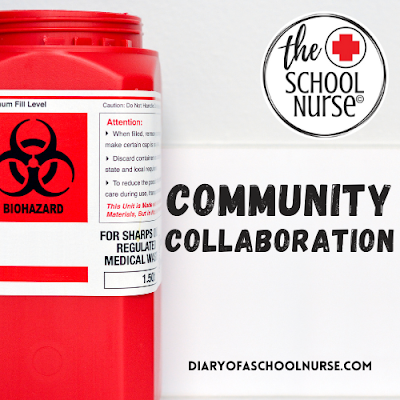
How can school nurse properly dispose of full sharps containers?

COMMUNITY COLLABORATION
+this post contains an affiliate link+


Helpful School Nurse Tip: One of the best ways to strengthen your school health program isn't always by increasing your budget—it's by building relationships within your community. Many local organizations are eager to support schools through donations, services, educational programs, and partnerships. The key is simply asking and building those relationships over time. One example? Our local fire department.

A Simple Community Partnership

When I first started at my school, the district spent hundreds of dollars each year disposing of full sharps containers. Those costs added up quickly and took away from the limited budget available for student health supplies.

About seven years ago, I reached out to our local fire department to see if they would be willing to dispose of one full sharps container each year at no cost to the district.

Thankfully, they agreed—and they've continued to provide this valuable service ever since.

That one conversation not only saved our school district money, but it also strengthened an already positive relationship with our local firefighters, EMTs, and paramedics.

It's a great reminder that sometimes the best solutions come from simply asking.


Think Beyond Your Budget

Community partnerships aren't just about saving money.

They can also provide:

  • Student and staff education
  • Health screenings
  • Guest speakers
  • Emergency preparedness training
  • Donated supplies
  • Volunteer opportunities
  • Professional expertise
  • Family support services

Sometimes the greatest value isn't financial—it's knowing who to call when someone needs help.

Community Partners to Consider

Every community is different, but here are a few organizations worth getting to know:

  • Fire Department
  • EMS
  • Local hospitals and healthcare systems
  • Health Department
  • Lions Club
  • Dental clinics
  • Vision providers
  • Food pantries
  • Mental health agencies
  • Public libraries
  • Community foundations
  • Local businesses
  • American Heart Association
  • American Lung Association
  • American Red Cross

For family resources, don't overlook 211.org. It connects families with local assistance for food, housing, utilities, mental health services, transportation, childcare, and many other community programs. You can learn more by visiting 211.org.

You don't have to build every partnership overnight.

Start With One Conversation

Building community partnerships doesn't happen overnight.

Start with one conversation.

Reach out to a local organization, introduce yourself, explain your role, and look for opportunities to work together.

You might be surprised how many people are eager to support your students and your school.

I'd Love to Hear From You!

What community partnerships have made a difference in your school?

Have you found a creative way to save money, provide additional services, or connect families with helpful resources?

I'd love to hear your ideas in the comments!


Having a great working relationship with your local fire department and EMT service is good- Saving your school district money is even better!


Grab some other community networking ideas with this online, anytime continuing education course!


Check out these other popular DOASN blog posts & links.


Sunday, September 15, 2013

School Nurse Office Decor and Set Up


What does your dream health center or

school nurse's office look like?

+ this post contains affiliate links+ 


Lately, I've been dreaming of a spacious, organized, lovely new health center!
Reality is... I'll have to make do with the space I have.  Since I've worked in the school setting for 17+ (seriously) years I realize that the space I have is GREAT!  However, I can always dream, right?!
 
Here are a couple of random office pictures:
 
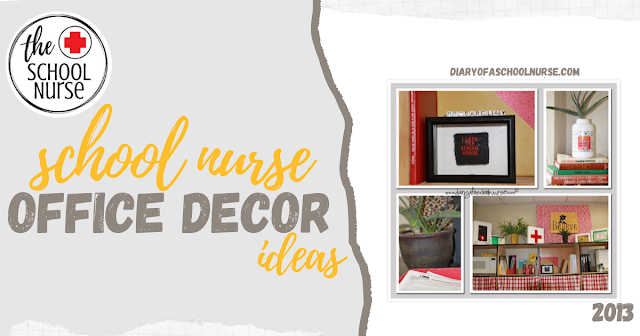
The above four pictures are from "my office".
I try to keep it somewhat organized- it is actually a rather large office and a space we use for extra storage, health charts, and vision & hearing screenings. 
 
This school year I was gifted a "new desk"-
it is really two tables pushed together in an L shape
and I'm sure the pieces are 20+ years old, but they weren't being used and are in great condition!
They beat the folding table and yucky old desk I had used for the last 6 years. 
Anyway.... one of the new desks has a topper on it for my computer monitor and the guys
found me short filing cabinets to fit under each side for
drawer space! I love it- I should have taken a picture :) 
I joke the new desk is so nice I finish twice as much work in half the amount of time!

 
Those are pictures of the school nurse's "waiting room" area.
There is a clip board for students to sign in and out,
free fruit (we get a basketful everyday from the wonderful cafeteria ladies),
and two old (!) cots for students to sit and wait for us. 
 
See the picture of the lockers? 
Below the picture we have the schedule printed for the kids...
then below that you see the little square colored pieces of paper? 
Those each correspond with a class period. 
If we have passes that need to be delivered for students we hang our passes there. 
Each class period we have 2-3 student messenger who sit a little round table below that sign-
they deliver passes for us, fill our water pitcher, make ice packs, and make us smile & laugh- remembering what it was like to be a teenager!

... school nurse treatment area desk ...


The above is actually a pencil drawing (from a former student) of a portion of the clinic are. 
This is where the students and staff are cared for!
It is a hodge-podge of old cabinets and desks
mixed with our new cots and desk chairs!
 
I've seen my share of health centers or nurse's offices
and so I realize how very lucky we are to have the space we have!
If I were allowed to dream though- I would redesign this space (a little bit!).
Moving walls probably aren't in my near future-
but if it were I have some grand plans in my mind!
 
My "short list" of dreams include:
  1. new office cabinets that match and are functional!
  2. a counter space area for supplies and an area for the students to check their blood sugar.
  3. new flooring.
  4. a new refrigerator- ours is very old!
  5. a new microwave- ours was purchased in 1992!
  6. one of these (affiliate link) FABULOUS ice makers! Although I would like to have one in  my home; I would LOVE to have one in my office. Can you imagine making ice packs on an as needed basis with these awesome little tiny nugget ice pieces?!  I dream of that day (is that weird?)! 

What does your nurse's office look like?

Do you love it?

Are there things you want to change in your office?


Friday, July 5, 2013

GSA, Student Attendance, and The School Nurse

General State Aid, Student Attendance,

 & The School Nurse

+ this post contains affiliate links +

Hopefully Helpful School Nurse Tip: School nurses provide a variety of services in the school setting.  One of them is encouraging regular school attendance.

NASN POSITION

It is the position of the National Association of School Nurses (NASN) that attendance at school is essential to student learning and success. The registered professional school nurse (hereinafter referred to as school nurse) is an integral member of the interprofessional school team, promoting regular school attendance and addressing chronic absenteeism by supporting students’ physical and emotional health and well-being.


As a school nurse in Illinois, I spent a lot of time researching General State Aid (GSA) at the end of the last school year, particularly how GSA and regular school attendance work together. I want to share my findings with you now, so you have the opportunity to do your own research before the new school year begins! 

Ready? Off we go!

 "What is General State Aid?" 

General State Aid (GSA) is just as complicated as it sounds.

Basically, GSA is a % of funds (money) school districts receive from the state
based on a very detailed, complicated, secretive formula that only several people in the state of Illinois truly understand :)

After reading a lot and talking to several school administrators this is my easy-to-understand summary:

I'm pretty sure the formula involves the actual amount of minutes per day students attend school. "School" is defined as actual academic classes; passing periods and lunch periods do not count.

The state looks at each school district and takes an average of their best 3 months. Then comes up with the amount of money the school district will receive.

Remember, I'm trying to make this explanation easy & just a basic summary :)

What does mean for The School Nurse?

After learning all of this, I began to think-
"How can I help my school district's attendance rate and GSA increase?" 

Familiar School Nurse's Office Scenario

Setting the Stage: The first bell rings and at least one student walks into the nurse's office and states:

Student: "My parents told me to try and make it today, but I don't feel well and I want to go home".

Nurse: Completes health assessment nothing alarming or potential contagious is found; student's complaints are vague. Nurse calls parents:
Parents: "I really want them to stay at school today. They were fine last night. I told them to try and make it today. What do you think?"
This is what I think... Since GSA is based on minutes, I decided to give the "try and make it" option a specific time. As long as the parent is in agreement then why not see if the student can "make it" for an actual/qualified half day of school attendance?  

In my school district a 1/2 day = 150 minutes of true academic classroom time and an actual full day = 300 minutes of true academic classroom time. See where I'm going with this?  I decided if my health assessment is within normal limits for school attendance, then I'll have students "try to make it" at least a 1/2 day & I'll give them a specific time to return if they still think they need to go home.  For easy reference, I keep the actual times written down on my desk.

What are your thoughts on GSA and The School Nurse?

  • Are you willing to do some research to see what times qualify in your district?
  • Do you think you might give "try and make it" scenarios a specific time this coming school year?

STUDENT ATTENDANCE GUIDELINES

Promoting regular student attendance is a team effort that benefits everyone, from the individual student to the entire school community. Regular attendance not only fosters academic success but also influences the school’s general state aid, which often depends on average daily attendance rates. This is why ongoing education about the importance of consistent attendance is vital for students, parents, and school staff alike.

Your district might already have specific attendance guidelines in place, but if not, feel free to use the sample guidelines linked below as a framework and tailor them to meet your school’s unique needs. Educating students on the benefits of regular attendance, engaging parents, and ensuring that school staff understand the role they play in supporting attendance goals can make a powerful difference.

By working together, we can create a supportive environment that encourages students to attend regularly and helps secure necessary funding to continue enhancing educational resources. Here's to fostering a culture of attendance, achievement, and collaboration—best of luck!

Click HERE for sample Student Attendance Reminders


 Check out these other popular DOASN blog posts & product links.