Showing posts sorted by date for query national nurse day. Sort by relevance Show all posts

Sunday, April 13, 2025

Supporting Students with Type 1 Diabetes: A School Nurse’s Role

Managing Type 1 Diabetes at School

+ This post contains affiliate links. +


Diabetes at School: What Every School Nurse Should Know About Type 1

Type 1 Diabetes (T1D) is one of the most medically complex chronic conditions managed in schools—and school nurses play a vital role in helping students stay safe, healthy, and ready to learn.

From blood glucose monitoring and insulin administration to Continuous Glucose Monitors (CGMs), insulin pumps, and emergency preparedness, there's a lot to learn. The good news? You don't have to figure it all out alone.

Whether you're brand new to school nursing or looking for a refresher, this guide will walk you through the essentials of supporting students with Type 1 Diabetes.

Type 1 Diabetes: The Basics

Type 1 Diabetes is an autoimmune condition. The pancreas stops producing insulin, the hormone needed to let glucose into the body’s cells for energy. People with T1D must balance insulin, food, and activity levels 24 hours a day, 365 days a year- no days off!

At school, that means:

  • Frequent blood sugar monitoring (fingersticks or CGM)

  • Scheduled or flexible insulin doses

  • Carb counting for meals/snacks

  • Emergency plans for highs (hyperglycemia) or lows (hypoglycemia)

Know the Signs of Highs and Lows

Low Blood Sugar (Hypoglycemia):
Can come on fast and be dangerous. 

Look for:

  • Shakiness or dizziness

  • Sweating

  • Confusion or irritability

  • Headache

  • Slurred speech

  • Seizure or loss of consciousness (in severe cases)

What to do: Follow the student’s Diabetes Medical Management Plan (DMMP). Most students will need 15 grams of fast-acting carbs, rechecked in 15 minutes. Always keep emergency glucose and glucagon nearby.

High Blood Sugar (Hyperglycemia):
Usually develops more slowly. 

Watch for:

  • Increased thirst

  • Frequent urination

  • Fatigue

  • Blurry vision

  • Nausea or vomiting (possible DKA warning sign)

What to do: Follow the DMMP, notify parent/guardian, and monitor for ketones if indicated.


Diabetes Technology Has Changed School Nursing

Diabetes care has changed dramatically over the past decade. Many students now use Continuous Glucose Monitors (CGMs), insulin pumps, or automated insulin delivery systems to help manage their diabetes throughout the school day.

These devices provide valuable information and can help improve blood glucose management, but they don't replace good communication or careful nursing assessment.

As you prepare to support a student with Type 1 Diabetes:

  • Become familiar with the diabetes technology your student uses.
  • Review the student's Diabetes Medical Management Plan (DMMP) to understand when school staff should intervene.
  • Know who receives CGM alerts and how your school responds when alarms occur.
  • Remember that technology is only one part of diabetes care. Students may still need blood glucose checks, snacks, insulin adjustments, or emergency treatment based on their symptoms and DMMP.

The more familiar you are with today's diabetes technology before an emergency occurs, the more confident you'll feel supporting your students.

Helpful Tip: Every student's diabetes technology—and Diabetes Medical Management Plan (DMMP)—may be a little different. Don't hesitate to ask the student, family, or diabetes care team to demonstrate how the device works and answer any questions before the school year begins.

What’s in a DMMP—and Why It Matters

The Diabetes Medical Management Plan (DMMP) is your go-to guide for managing each individual student’s care. It’s typically written by the student’s diabetes care provider and signed by the parent/guardian.

It covers:

  • Blood glucose monitoring schedule

  • Insulin dosing and delivery method (injections or insulin pump)

  • Meal and snack plans

  • Exercise considerations

  • Emergency actions for hypoglycemia and hyperglycemia

  • When to call home—or 911

Keep it updated and easy to access.

Remember:

DMMP = written by the healthcare provider and contains the medical orders.

Individualized Healthcare Plan (IHP) = created by the school nurse to guide nursing care and communication.

School procedures = district policies that help ensure safe, consistent diabetes management.

Understanding the purpose of each document helps everyone work together safely.

Questions to Ask Parents Before School Starts

Every child manages Type 1 Diabetes a little differently. While the Diabetes Medical Management Plan (DMMP) provides your medical orders, a conversation with the parent or guardian can help you better understand the student's daily routine and individual needs.

Consider asking questions like:

Daily Diabetes Management

✔ Tell me about how and when your child was diagnosed with Type 1 Diabetes.

✔ Tell me about your child. What should I know before the first day of school?

✔ What diabetes technology does your child use (CGM, insulin pump, injections)?

✔ Does your child usually recognize when their blood sugar is low or high?

✔ Are there symptoms that are unique to your child?

School Routine

✔ How independent is your child with diabetes care?

✔ Will they count carbohydrates independently or need assistance?

✔ Where do they usually check their blood sugar or administer insulin?

✔ Are there any classroom accommodations that have worked well in the past?

Communication

✔ When would you like me to contact you?

✔ How do you prefer to communicate during the school day?

✔ Who should we call if you're unavailable?

Emergencies

✔ Has your child ever experienced severe hypoglycemia?

✔ Have they ever needed glucagon?

✔ Have they ever been hospitalized for diabetic ketoacidosis (DKA)?

✔ Are there any concerns you'd like us to be especially aware of?

Supplies

✔ What diabetes supplies will be kept at school?

✔ How often should we check expiration dates or replenish supplies?

✔ Is there anything else that helps your child have a safe and successful school day?

Helpful Tip: The best diabetes care happens when school nurses, families, students, and healthcare providers work together. Parents are the experts on their child, while the Diabetes Medical Management Plan (DMMP) provides the medical orders that guide care at school. Use your first conversation to build trust, learn about the student's daily routine, and encourage families to reach out anytime questions or concerns arise.

Know the Law: Diabetes Care in Schools

In Illinois, the Care of Students with Diabetes Act (105 ILCS 145/) outlines specific responsibilities for schools and staff supporting students with diabetes. It requires schools to:

  • Follow the student’s DMMP as written by their healthcare provider

  • Allow capable students to self-manage their care (including testing and insulin) in the classroom or elsewhere

  • Ensure trained school staff are available to recognize and respond to diabetes-related emergencies

Not in Illinois? Be sure to review your own state's laws and district policies before the school year begins.


Preparing Your School Team

Supporting a student with Type 1 Diabetes is a team effort. While the school nurse coordinates diabetes care, many other school staff members play an important role in helping students stay safe throughout the school day.

As you prepare for the school year, make sure:

✔ Students have immediate access to glucose tablets, juice, snacks, water, and emergency medications as outlined in their Diabetes Medical Management Plan (DMMP).

✔ Teachers, coaches, substitute teachers, cafeteria staff, bus drivers, and other designated personnel know how to recognize the signs of hypoglycemia and hyperglycemia—and understand when and how to get help.

✔ Staff members responsible for supervising field trips, extracurricular activities, or after-school events understand the student's diabetes management needs before leaving campus.

✔ Emergency supplies are readily available, and trained staff know where they are located.

When everyone understands their role, students with Type 1 Diabetes can participate safely and confidently in all aspects of school life.

Communication Is Key

A solid communication plan with families helps keep everyone on the same page. Use daily logs, messaging apps, or email—whatever works best. Ask questions. Clarify unclear orders. Keep the DMMP updated.

And most importantly: listen to the student. They live with this every day. Even young students often know their bodies better than anyone. Listen to their concerns, encourage self-advocacy when appropriate, and partner with families and healthcare providers to provide safe, individualized care.

My Diabetes Organization System

Over the years, I've found that having a simple, consistent system makes diabetes management much less stressful—for me, my staff, and my students.

Here are a few habits that have worked well in my health office:

✔ Keep all current Diabetes Medical Management Plans (DMMPs) together in one easy-to-access binder (or secure digital folder).

✔ Review every student's DMMP before the school year begins to identify medication changes, supplies, accommodations, and staff training needs.

✔ Create an Individualized Healthcare Plan (IHP) to guide nursing care and develop easy-to-follow resources for school staff.

✔ Track expiration dates for glucagon, emergency medications, and other diabetes supplies before they become a problem.

✔ Prepare for substitutes, field trips, extracurricular activities, and emergencies before they happen—not during them.

✔ Communicate early with families, healthcare providers, teachers, coaches, and other staff members so everyone understands their role in supporting the student. And advocate for 504 Plans when needed or required.

Final Thoughts

Managing Type 1 Diabetes may feel overwhelming at first, but it becomes much easier as you build routines, learn from your students, and develop systems that work for your school.

Remember—you don't have to know everything on day one. Ask questions, keep learning, and lean on your school nurse community whenever you need support.

Looking for editable diabetes resources? You'll find my T1D templates, teacher tips, IHPs, and 504 plans HERE!

Ten Resources for School Nurses & Families

1. American Diabetes Association – Safe at School
https://diabetes.org/safeatschool Includes training resources, sample care plans, and guidance on students’ legal rights related to diabetes care at school.

2. National Association of School Nurses (NASN) – Diabetes Resources
https://www.nasn.org/nasn-resources/resources-by-topic/diabetes Offers evidence-based practice tools, care coordination tips, and policy updates for managing diabetes in the school setting.

3. Centers for Disease Control and Prevention (CDC) – Managing Diabetes
https://www.cdc.gov/diabetes/managing/children.html Provides guidance for supporting children with diabetes, including school accommodations and safety measures.

4. JDRF (now Breakthrough T1D) – T1D School Resources
https://www.breakthrought1d.org/t1d-resources/school/ Features school readiness tips, 504 Plan tools, classroom management strategies, and parent resources.

5. Joslin Diabetes Center – School Nurse Information
https://joslin.org/services/pediatric-diabetes/educational-programs/resources-school-nurses Educational tools for school staff, including diabetes care plans and communication checklists.

6. Beyond Type 1 – Educator Resources
https://beyondtype1.org/t1d-and-school/ Practical tips for school staff and families, covering everything from school supplies to emergency protocols.

7. Oregon School Nurses Association – T1D Toolkit
https://www.oregonschoolnurses.org/oregonschoolnurses/resources/toolkits/t1d-toolkit-for-school-nurses Toolkit with editable care plans, delegation guidance, and best practices for diabetes management in schools.

8. Children With Diabetes – School and Legal Support
https://www.childrenwithdiabetes.com/for-parents/diabetes-at-school/ Guidance on students’ rights, 504 Plan tips, and advice for ensuring safe diabetes care in school.

9. Association of Diabetes Care & Education Specialists – T1D School Strategies
https://www.adces.org/store/online-education/detail/going-to-school-with-t1d-essential-insights-strategies-v2 Online course designed for educators and parents to improve diabetes care understanding in school settings.

10. KidsHealth – Diabetes in Children
https://kidshealth.org/en/parents/diabetes.html Family-friendly diabetes education, including school-specific tips, sick day management, and glucose monitoring basics.


TYPE 1 DIABETES

Saturday, April 5, 2025

Asthma At School

Understanding Asthma in Schools:

What Every School Nurse Needs to Know

+ This post contains affiliate links. +


Asthma is one of the most common chronic health conditions you'll encounter as a school nurse—and one of the most important to prepare for before the school year begins.

The good news? You don't have to memorize everything. Strong asthma management starts with good systems, updated documentation, staff education, and trusted resources.

Whether you're caring for one student with asthma or twenty, this guide will help you build confidence in supporting students throughout the school day.

What is Asthma?

Asthma is a chronic disease that affects the airways in the lungs, making them inflamed and narrow, which can make breathing difficult. Asthma symptoms can vary from person to person but typically include:

  • Wheezing (a whistling sound when breathing)

  • Shortness of breath

  • Coughing, especially at night or early in the morning

  • Chest tightness

Asthma attacks occur when the airways become even more inflamed and narrow, making it harder to breathe. Triggers can include allergens (like pollen or pet dander), irritants (such as smoke or strong odors), physical activity, and even cold air or stress.

Prevalence of Asthma in Schools

Asthma is one of the most common chronic conditions among children in the United States. According to the Centers for Disease Control and Prevention (CDC), about 1 in 12 children has asthma. This means that in many schools, it’s likely that several students will be managing asthma on a daily basis.

Children with asthma may have different levels of severity. Some may only experience occasional symptoms, while others may face frequent asthma attacks that require medication or even emergency medical care. As school nurses, we need to be prepared to manage asthma in both mild and severe cases.

Building Your Asthma Management System

When managing asthma in schools, it’s important to understand the distinct roles and differences for the following types of forms / documents!

Asthma Action Plan, Individualized Healthcare Plans (IHPs), and State Policies & School Procedures

  1. Asthma Action Plan (AAP) – An Asthma Action Plan (AAP) is a written, personalized guide created by the student’s healthcare provider, usually their doctor, to manage their asthma. This plan provides clear instructions for both the student and school staff on how to handle asthma symptoms and prevent attacks. It’s designed to help everyone involved know what steps to take during a specific student's asthma episode. There are many free examples available online to help create or update an AAP. Helpful Tip: Review Asthma Action Plans before the school year begins and anytime changes are made. Becoming familiar with each student's plan before an emergency occurs helps you respond more confidently. A comprehensive Asthma Action Plan typically includes:
    • Personalized triggers – What sets off the student's asthma, such as dust, pet dander, or cold air.
    • Symptoms to watch for – How to recognize the early signs of an asthma attack, such as coughing, wheezing, or chest tightness.
    • Medications – Detailed instructions about daily medications (like inhalers) and emergency medications (such as rescue inhalers).
    • Emergency actions – Steps to take if the student’s asthma symptoms get worse, including when to call for help or seek medical attention.
    • Contact information – Emergency contact numbers, including the student’s doctor and parents.
  2. Individualized Healthcare Plan (IHP) – Written by the school nurse, the IHP is a comprehensive plan that outlines the student’s health needs and how nursing staff will meet those needs during the school day. For students with asthma, and IHP would most likely include the nursing assessment, nursing diagnoses, goals, interventions, expected outcomes, and an evaluation area. IHPs should be reevaluated and updates as needed, but at least each school year.  
  3. State Policies and School Procedures – When it comes to managing asthma in schools, it’s important to understand the difference between state policies and school procedures—both are essential, but they serve different purposes.
State Policies- State policies are laws or mandates passed by the state legislature. In Illinois, for example, the law 105 ILCS 5/22-30 allows students to carry and self-administer their asthma medication (like an inhaler) at school, as long as the proper documentation is provided by the parent/guardian and the student’s healthcare provider.

These laws are designed to protect students' rights and ensure schools follow standardized safety guidelines across the state. In Illinois, 105 ILCS 5/22-30 requires schools to:

  • Permit self-carry/self-administration of asthma medication with appropriate written authorization

  • Ensure staff are informed and trained on the school’s asthma policies

  • Maintain an asthma emergency response protocol

  • Request an Asthma Action Plan for each student diagnosed with asthma

School Procedures- School procedures are the step-by-step processes each school or district puts in place to carry out the state policy. They are the way each school or district follows the law, based on their own staff, setup, and available resources. Examples of school-level procedures include:

  • How inhalers are stored in the nurse’s office (if not self-carried)
  • When and how staff are trained to recognize and respond to asthma symptoms
  • Which forms need to be submitted and how often
  • Protocols for field trips, gym class, or after-school activities

Supporting Students with Asthma

As the primary healthcare provider in the school setting, the school nurse plays a key role in managing asthma. Here’s what school nurses should know and do to ensure that students with asthma receive the best care:

✔ Review Asthma Action Plans

✔ Develop nursing care plans

✔ Educate school staff

✔ Monitor environmental triggers

✔ Promote correct inhaler technique

✔ Coordinate with families and providers

✔ Prepare for emergencies 

Learning from an Asthma Expert


One of the best parts of being a school nurse is that there's always something new to learn.

That's why I was excited to invite Dr. Juanita Mora, CEO of the Chicago Allergy Center and National Spokesperson for the American Lung Association, to share her expertise with members of GROUNDS FOR GROWTH™.

Our discussion covers practical topics school nurses face every year, including:

✔ Asthma Action Plans
✔ Common asthma triggers in schools
✔ Rescue inhaler updates
✔ Practical strategies for supporting students with asthma
✔ Live questions from school nurses

👉 Learn more about GROUNDS FOR GROWTH™ and upcoming member resources below. 

Final Thoughts

Every student with asthma deserves to feel safe, included, and ready to learn.

As school nurses, we help make that happen by building strong systems, educating school staff, partnering with families, and preparing for emergencies before they occur.

Preparation builds confidence—and confidence leads to better care.

Beyond the Asthma Action Plan

Ideally, every student with asthma would have an updated Asthma Action Plan on file each school year—but in reality, that doesn’t always happen. When symptoms start to affect a student’s ability to learn, participate fully in class, or join in school activities, an IHP and sometimes even a 504 Plan are the next best way to make sure the right supports are in place.

That's why I created these editable Asthma resources. Whether you need an IHP, 504 Plan, or Teacher Tips, each resource is designed to save time while helping you create clear, student-centered plans that support both health and learning.

Building Your Asthma Toolkit


Patient Education Matters

On the surface (no pun intended!), this video is funny—but it also highlights an important lesson for school nurses.

Students need to understand their own health conditions, recognize symptoms, know when and how to use their medications, and feel comfortable asking for help when something doesn't feel right.

Patient education is an important part of what we do every day, and sometimes a little humor is the perfect reminder of why it matters.


Top 10 Asthma Resources for School Nurses & Families

  1. Centers for Disease Control and Prevention (CDC) – Asthma
    https://www.cdc.gov/asthma Offers data, management tips, educational materials, and CDC’s National Asthma Control Program resources.

  2. American Lung Association – Asthma
    https://www.lung.org/lung-health-diseases/lung-disease-lookup/asthma
    Provides asthma basics, treatment info, downloadable Asthma Action Plans, and school-focused resources.

  3. National Heart, Lung, and Blood Institute (NHLBI)
    https://www.nhlbi.nih.gov/health-topics/asthma Offers in-depth clinical guidelines and educational resources for professionals and families.

  4. Asthma and Allergy Foundation of America (AAFA)
    https://www.aafa.org A comprehensive resource for asthma facts, webinars, support groups, and multilingual asthma action plans.

  5. Allergy & Asthma Network
    https://www.allergyasthmanetwork.org Focuses on patient education and advocacy; includes school resources, handouts, and inhaler technique videos.

  6. Healthy Schools Campaign – Managing Asthma in Schools
    https://healthyschoolscampaign.org Offers school-specific asthma policies, training modules, and action plan development guides.

  7. National Association of School Nurses (NASN)
    https://www.nasn.org/nasn-resources/practice-topics/asthma Curated asthma resources for school nurses, including toolkits, webinars, and evidence-based practices.

  8. KidsHealth – Asthma Center
    https://kidshealth.org/en/parents/asthma.html Parent-friendly and kid-friendly information, plus printable guides and student asthma support tips.

  9. Global Initiative for Asthma (GINA)
    https://ginasthma.org International guidelines for asthma management and prevention; excellent for updated care standards.

  10. Environmental Protection Agency (EPA) – Asthma and Indoor Air Quality
    https://www.epa.gov/asthma Offers resources about managing asthma triggers in the school environment and improving air quality.


Sunday, September 24, 2023

Relaxation Room for Students with Anxiety

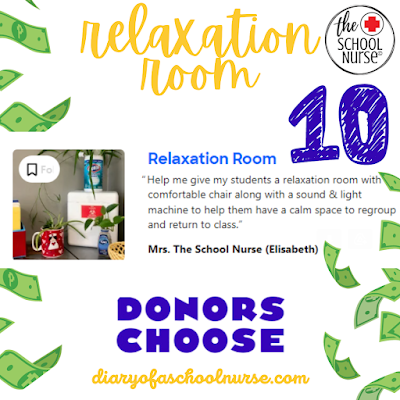
How The School Nurse Used DonorsChoose to Fund a Relaxation Room for Students; especially those with anxiety.

+ This post contains affiliate links. +


Hopefully Helpful School Nurse Tip: Anxiety is a mental health issue that affects many people, including teenagers. Actually, anxiety disorders are the most common mental health disorders among teenagers.  Approximately 1 in 3 teenagers experiences some form of anxiety during their teenage years. Read on to see how I used a DonorsChoose project to create a Relaxation Room for my students who experience anxiety during the school day.

Inspired by my school’s Sensory Room, I created a Relaxation Room! This room was FULLY FUNDED by my 10th DonorsChoose project & is available to all students at my school 😊 Get all the details & watch the video below ⬇️ 

The Relaxation Room Project 
As school nurses, you've probably experienced a student complaining of anxiety. The symptoms can vary, but many include physical symptoms such as: headaches, stomach aches and muscle tension. Some students may cry, feel short of breath and feel nervous. In addition, some students may complain of excessive worrying, feeling restless, having trouble sleeping, feeling irritable, and having difficulty concentrating. 

A recent study by the National Library of Medicine reported that nearly 15% of young people ages 10-19 experience a mental health disorder. At my school, we have reports that 18.57% of our student population has a known mental health condition.

My options used to be limited if the student denied school counseling services yet still wanted to try and stay at school.  Not anymore thanks to a fully funded DonorsChoose project!  Now, my students have another option- ten minutes (phone free) in the new Relaxation Room. 

Even though this room is small (maybe 8 feet x 8 feet) & it also has a sink, a door to a water closet (toilet only), and several vintage filing cabinets, it is the perfect size for this project. 


The relaxation room is complete with a reclining massage chair, side table with built in outlets, a galaxy light projector, and a calming 4 foot tall, fake fish tank! The first day of use this room made a positive impact! 

Watch the video below to see how DonorsChoose helped me turn an old cot room from drab to fab!  


We allow 15 minutes and that seems to work great!
However, if students need more time that is allowed too.
I kept data for my EOY BOE report and over 90% of the students who visit the nurse's office are able to return to class v. going home! 
I credit this room for many of those return to class visits!


Can School Nurses Create DonorsChoose Projects?

DonorsChoose is available to most public school staff; check with your school district for their particular guidelines. Then you can read all about the projects I've completed HERE & start your very own project HERE!


The three main reasons I love using DonorsChoose are: 

  1. DonorsChoose is very user friendly! They provide you with step-by-step directions. 
  2. DonorsChoose collects all donated money. They purchase the items you've selected.
  3. DonorsChoose has the items shipped directly to your public school!

To date, I've received over $4,600 in funding to purchase items for my school nurse office & you can too! I advertise my projects on my personal Facebook page and ask friends and families to share with others. I have received donations from friends, families, businesses, and even strangers who are looking to support public schools!


start your very own project HERE


 Check out these other popular DOASN blog posts & product links.


Sunday, August 13, 2023

Individualized Healthcare Plans and The School Nurse

A brief overview of IHPs & School Nurses

+ This post contains affiliate links. +


Helpful School Nurse Tip: An Individualized Healthcare Plan (IHP) doesn't have to be perfect. Think of it as a working nursing document that grows with the student and changes as their healthcare needs change.

IHP Overview

Individualized Healthcare Plans (IHPs) have been part of school nursing practice for decades and remain one of the most important tools school nurses use to provide safe, individualized care for students with complex health needs.

Real quick—the terms "health care" and "healthcare" are often used interchangeably, but there is a subtle difference between the two.

The phrase health care typically refers to providing medical services to treat illness or injury, while healthcare is a broader term that includes promoting health, preventing illness, and supporting overall well-being.

That distinction is important in school nursing.

An Individualized Healthcare Plan isn't simply a document about treating a medical condition. It helps organize the nursing care, health promotion, accommodations, and interventions a student may need to safely participate in the school day.

Based on the nursing process and developed by the school nurse, an IHP is written by the school nurse, for the school nurse. It serves as the nursing foundation from which other school health documents—such as Emergency Action Plans (EAPs), staff procedures, accommodations, and communication tools—may be developed to support a student's health, safety, and academic success.

Because school nursing practice varies from state to state, every IHP should be developed in accordance with your state's Nurse Practice Act, school nursing standards, district policies, and current evidence-based practice.

The IHP is created by the school nurse for the school nurse.

NASN Position Statement

The National Association of School Nurses (NASN) describes the role of the school nurse this way:

"It is the position of the National Association of School Nurses (NASN) that the registered professional school nurse (hereinafter referred to as school nurse) initiates and develops an Individualized Healthcare Plan (IHP) for students whose healthcare needs require more complex school nursing services.  An IHP is a plan of care written by the registered nurse for students with or at risk for physical or mental health needs (ANA & NASN, 2017).  It is the responsibility of the school nurse to annually evaluate the IHP, as well as to update the plan if deemed appropriate, to reflect changes in the student’s healthcare needs and address nursing interventions and/or student healthcare outcomes."  NASN, 2023 IHP Position Statement

Individualized Healthcare Plans vs. Emergency Action Plans

One of the biggest misconceptions new school nurses have is believing that the Individualized Healthcare Plan should be shared with everyone who works with the student.

In reality, the IHP is a nursing document that guides nursing assessment, planning, interventions, and evaluation.

Most school staff don't need the entire IHP.

Instead, they typically need Emergency Action Plans (EAPs), school procedures, accommodations, or specific health instructions that clearly outline what to do, when to respond, and who to contact during a health event.

Providing the right information to the right people helps protect student privacy while ensuring staff are prepared to respond confidently when needed.

As school nurses, we play an important role in promoting best practices—protecting confidentiality while helping create a safe and supportive learning environment for every student.

Writing Your First Individualized Healthcare Plan

Writing your first Individualized Healthcare Plan can feel intimidating, but it gets easier with practice.

Remember, your goal isn't to create the perfect IHP—it's to create a nursing plan that clearly guides the care your student needs during the school day.

Every district has different expectations, so use your state's Nurse Practice Act, district policies, and school nursing standards to guide your documentation.

Over the years, I've created editable IHP templates to help school nurses spend less time formatting documents and more time focusing on student care. Each template is fully editable and can be customized to fit your district's needs.

Templates provide a starting point—not a finished product. They help ensure you don't overlook important information while still allowing you to individualize each student's plan.

View my digital IHP options here.


Condition-Specific IHP Templates

As my resource library continues to grow, I'm also creating condition-specific Individualized Healthcare Plans for some of the health conditions school nurses encounter most often.

Current templates include:

  • Asthma
  • Seizure Disorders
  • POTS

More templates are added as they're completed.

Continue Learning

If you're interested in learning more, these resources may also be helpful:


 Check out this time saving tool: