Hopefully Helpful School Nurse Tip: Did you realize the idea of school nursing came about as an experiment? Luckily for us, the experiment was greatly successful! Read on to learn more...
How did it become that a nurse was needed to work in the school setting so many years ago?
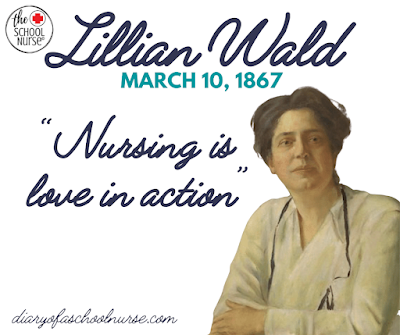
Lillian Wald's pioneering work in public health nursing laid the groundwork for the evolution of nursing practices in various settings, including schools. Through her establishment of the Henry Street Settlement and the Visiting Nurse Service of New York, Wald emphasized community-based care, preventive health measures, and a holistic approach to meeting the unique healthcare needs of underserved populations.
While her focus was more community health related, Wald's principles of health promotion, education, and the provision of care within the context of the community had a profound influence on the broader field of nursing; i.e. school nursing. As schools increasingly became recognized as vital community hubs, the principles Wald championed, such as addressing social determinants of health and advocating for the well-being of children, indirectly influenced the development of school nursing programs. She also advocated for the first ever NYC school nurse, Lina Rogers!
Her legacy in public health nursing continues to resonate in the ethos of school nursing, promoting a community-oriented, preventive care model that recognizes the interconnectedness of health within the school environment and the broader community.
the history of school nursing
School Nursing Started As An Experiment
In the late 1800s/early 1900s New York City allowed
1 nurse to work with 8,671 students.
The goal was simple, right?
exclude students who needed to be excluded from school
provide follow up care with those students and their families
enable those excluded students to return to school as soon as possible
That school year, the absenteeism rate decreased by 90%!
The experiment was so successful that New Year City hired 25 more nurses to work in their schools!
Although some of the needs students face today might be
a little different than when Lillian Wald began the school nurse journey;
the goal is still the same-
Promoting health in the school setting so students are ready to learn!
Helpful School Nurse Tip: Did you know that school nurses are responsible for making sure their students have met the compliance for the health requirements required by their state? Read on for some hopefully helpful tips...
What health forms are required for school?
So you landed your dream job as a school nurse—now what? One of your first tasks will be gathering and reviewing all your students’ state-required health forms. These usually include physical exams, dental exams, and eye exams. Each state sets its own requirements, so check with your state department of health for specifics. Most of these forms are completed by a licensed provider outside school and then submitted to you. But why?
History of School Health Forms
Since the late 1800s, school nurses have promoted health for students, families, staff, and communities. Requesting, tracking, and managing student health records helps ensure students are healthy and ready to learn. Though this can feel overwhelming, it’s essential, especially to know which students have ongoing health conditions or require medications.
Why are health forms required for school?
Parents and students often ask why these forms are necessary. The short answer: meeting health requirements protects not only the individual student but also the entire student body by helping schools monitor and prevent disease spread.
These requirements are backed by state laws and district policies, which give school nurses the authority to enforce compliance and follow up as needed.
Handling Non-Compliance
If families don’t submit required forms, it’s important to have a clear follow-up process. This might include reminder letters, phone calls, or working with school administrators to ensure compliance. Some districts have specific procedures or consequences for missing documentation, so be sure to familiarize yourself with your school’s policies.
Staying Organized with Required School Health Forms
Find out your state’s specific requirements and create a plan to track compliance. For me, that means using a Google Sheet alongside Skyward reports. I also keep non-compliant health charts in a labeled plastic banker’s box for quick access.
What works for one nurse might not work for another—try different systems until you find what fits your style and your school’s needs. Pre-COVID, I consistently reached 100% compliance; the pandemic has complicated things, but persistence is key. Check out this DOASN blog post on organizing school health charts HERE.
Protecting Confidentiality
Remember to protect student health information by following HIPAA and FERPA guidelines. Keep records secure and only share health information with authorized staff or parents.
Each state has rules listing the minimum health requirements students must meet in order to attend school.Try searching your state + school health requirements to locate your specific state school health requirements.
Helpful School Nurse Tips: Knowing the health conditions of your students will prepare you to be able to provide appropriate care for all of your students. In addition, you can use this information to calculate the % of your students who have chronic health conditions, create Individualized Healthcare Plans, and other health related Action Plans.
Health History Purpose
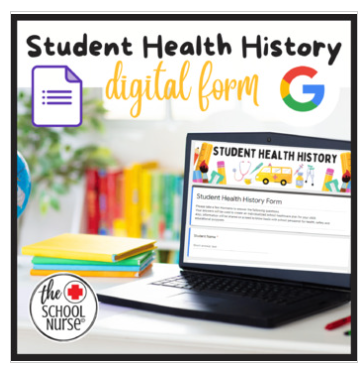
The purpose of this digital student health history form is to provide an easier, yet formal way, for the school nurse to gather (collect data) on medical conditions for current students. Although this digital form is 100% editable, it currently offers parents a way to inform the nurse of the following:
Current health concerns
Explanation of the health concern
Description of how the health concerns impacts the student's school day
Requested accommodations the might benefit the student throughout the school day
Doctor contact information
As you can see, this digital health history form provides parents a chance to subjectively provide the school nurse with an overview of their child's current health conditions. The school nurse can then ask for needed / required follow up information from the student's parents and/or physician.
How To Collect A Student Health History
Have you ever had a parent call you with an update or have a child give you a verbal update? Those are great, but usually you prefer to have something is writing too. This digital student health history is a great initial data collection tool. Use this form within a follow up email - just make sure your Google settings are set so you receive notification when the form is completed. Follow up emails give you a chance to recap information from the conversation, review discussed accommodations, ask permission to share information with staff on a need to know basis, and ask any questions that you might have thought of since the conversation.
Why A Health History Is Important
Accurate student health histories are great!
Knowing what to do with the information from those health histories is even better!
Digital Health Records-Many schools use some sort of digital school management software; such as Skyward, SASI, PowerSchool etc. What program does your school us? IS there is a way to incorporate health history information into your school management software system? If so, use it :) It might seems time consuming at the moment, but you will save time in the long run.
Health Conditions Lists- Many moons ago, I used to create Excel Health Concern lists- this was my only option at the time and so it worked for me. I would create a column filled spreadsheet and sort and organize as needed! Thankfully now, I can use my school's school management software (Skyward) to organize this same information! Skyward allows the ability to add health concern information as a "Health Condition". Then, "Health Condition" reports can be created by grade level, graduation year, teacher, etc. These reports also provide an overall school summary including the number of students with each health condition. This information is very valuable for your end of the year (EOY) report for your school administration, school board, and/or supervisor.
Healthcare Plans- Use the gathered health history information to create individualized healthcare plans for your students. There are many FREE and paid examples of healthcare plans all over the Internet- just Google what you are looking for. Maybe you don't think you have enough time to create a healthcare plan for every student who might need one- that is OKAY! You can always create a generic plan to put in place for specific health conditions- asthma, seizures, food allergies etc. Then, you can decide which students need their own specific emergency action plans from their private physicians and use your time to encourage parents to provide those completed emergency plans to you.
Emergency Action Plans- Emergency Action Plans (EAP) are needed for students with known acute or chronic health conditions which have the potential to turn into a medical emergency while attending school or a school sponsored even and/or the health condition has the potential to negatively impact the student's learning process. There are many free and paid examples available online- again, just search what you are looking for many examples should appear.
Medication Forms- Knowing what medications a student is prescribed is nice to know. This knowledge can help you see the "bigger" picture. Many times students only take medication at home, but sometimes at school too. If medication is needed during school hours, then most districts require a physician's order and sometimes even have a specific form that needs to be completed. You can view medication form examples HERE. If a specific medication is included on an EAP then a separate medication form is typically not required.
Procedure Forms- As you filter through your student health history forms, you might find that a student requires a nursing procedure completed during school hours. These procedures might consist of: dressing change, g-tube feed, suctioning, catheterization, etc. Just like a doctor's order is required to administer medications in the school setting, a doctor's order should be on file in order for the nurse to complete any sort of nursing procedure in the school setting. Years ago in Illinois there was a "yellow manual" full of nursing procedures that may need to be completed in the school setting. I don't remember who published the manual and I don't have it available at the moment, but I will update this blog post if I find it! In the meantime complete an Internet search and I'm certain many examples will be available.