Building Medication Systems That Work
Practical Medication Management for School Nurses

Medication Administration Is More Than Giving a Pill
Medication management involves much more than handing a student a medication cup.
Every day, school nurses are responsible for coordinating physician orders, obtaining parent authorizations, securely storing medications, documenting every dose, monitoring for side effects, communicating with families, preparing medications for field trips, and making sure emergency medications are ready when needed.
The more responsibilities you juggle, the more valuable a dependable system becomes.

Build Medication Systems Before You Need Them
One lesson I've learned over the years is that it's best to create medication systems before things become hectic—but also be flexible enough to adjust them as your needs change.
In my office, two nurses administer medications throughout the day. Years ago, we found ourselves asking questions like:
"Did you already give this student their medication?"
"Did this student already come down?"
"Who documented that dose?"
Those conversations happened often enough that we realized something needed to change.
When you're asking the same questions over and over, it's usually a sign that your system—not your staff—needs improvement.
We didn't need to work harder.
We needed better systems, not more stress!
Looking back, improving our systems made one of the busiest parts of our day feel much more predictable. Today, we use consistent routines for daily medications, PRN medications, emergency medications, documentation, and inventory.
They may seem simple, but together they help our office run more efficiently, reduce the risk of errors, and support safe medication administration.
Every District (and school) Will Look Different
Your medication room probably won't look exactly like mine.
Your district's policies may be different.
Your student population may be different.
Your documentation system may be different.
And that's okay.
The goal isn't to copy another nurse's office.
The goal is to build systems that make sense for your school while following your district's procedures and your state's requirements.

Small Systems Make a Big Difference
You don't have to overhaul everything overnight.
Start by improving one process at a time.
Some ideas include:
- A consistent medication check-in routine
- An organized system for daily medications
- Clearly labeled PRN medications
- Easily accessible emergency medications
- A reliable documentation workflow
- Regular inventory checks
- Calendar reminders for medication expirations
- A process for field trips and end-of-year medication pickup
Over time, those small improvements become habits—and those habits make your day much easier.
SMALL SYSTEMS BIG IMPACT
✔ Daily Medications
✔ PRN Medications
✔ Emergency Medications
✔ Documentation
✔ Inventory
✔ Communication
Understanding Your Professional Responsibilities
Strong medication systems are only one part of safe medication administration.
School nurses must also understand the legal, ethical, and professional responsibilities that guide medication practices within their state and district.
While procedures vary across the country, there are several key concepts every school nurse should become familiar with.
School nurses function under their state's Nurse Practice Act, which defines the legal scope of practice and responsibilities for licensed nurses. Administering medications is a task that falls squarely within this scope, but it comes with specific guidelines:
Delegation: Nurses must understand which tasks, if any, can be delegated to unlicensed assistive personnel (UAP). State laws vary widely, but most require that the school nurse assess the situation and provide training and supervision when delegation is permitted.
Clinical Judgment: Nurses are responsible for assessing whether it is safe to administer a medication based on their training and the provided orders. They must also monitor for potential side effects or adverse reactions.
%20(2).png)
Understanding Scope of Practice
Medication administration falls within a school nurse's professional scope of practice, but it also requires sound clinical judgment and an understanding of your state's Nurse Practice Act.
Some important responsibilities include:
Medication Orders: Most states require a written order from a licensed healthcare provider and parental consent before a school nurse can administer any medication.
Storage and Handling: Nurses must follow state regulations regarding the safe storage of medications, which often include keeping them in a locked cabinet and maintaining controlled substances under stricter conditions.
Documentation: Proper record-keeping is critical. Nurses must document every dose administered, including the time, dosage, and any observations or reactions.
Standing Orders: Some states allow standing orders for common medications like epinephrine for anaphylaxis or albuterol for asthma emergencies. Understanding what is allowed in your state is crucial.
Free Medication Training Guide!
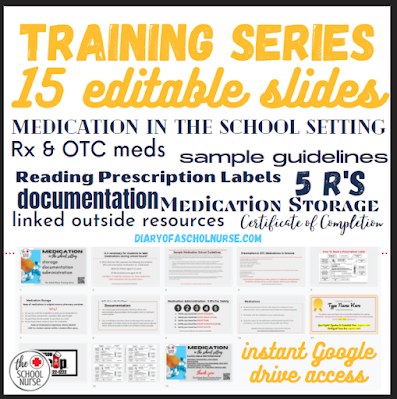
Understanding delegation requirements, including which tasks (if any) may be delegated to unlicensed assistive personnel (UAP) is another important topic.I created a free Medication in the School Setting Training Guide to walk you through many of the basics of medication management in schools, including:
- Policies and procedures
- Medication forms
- Storage
- Administration
- Inventory
- Documentation
- Helpful resources and references
Whether you're brand new to school nursing or simply looking for a refresher, I hope you find it helpful.
%20(1).png)
Key Considerations for School Nurses
Training and Competence School nurses must be well-versed in administering various forms of medications, including oral, topical, inhaled, and injectable forms. They should also be trained in emergency response protocols, such as administering epinephrine or glucagon.
Delegation and Supervision When delegating medication administration to UAP, the school nurse must ensure they are trained and competent to handle the task. Regular evaluations and ongoing communication are essential to maintain student safety.
Parental and Provider Communication Clear communication with parents and healthcare providers is essential. Nurses often serve as liaisons, ensuring that orders are accurate, medications are provided in the original pharmacy-labeled container, and any changes are promptly updated.
Emergencies and PRN Medications Nurses must be prepared to administer emergency medications like epinephrine, naloxone, or seizure rescue medications. Procedures for these situations should be clearly outlined and practiced through drills or simulations.
Common Challenges and Best Practices
Challenge: Students forgetting their medication at home or arriving without required documentation.
System: Develop clear policies and communicate expectations with families at the start of the school year. Use reminders and follow-up systems as needed.
Challenge: Balancing medication responsibilities with other nursing duties.
System: Streamline processes with electronic health record systems and standardized documentation forms.
Challenge: Managing medication inventory.
System: Follow district policies & procedures for counting, logging, and storing medications.
Final Thoughts
Medication administration isn't about having the perfect medication cabinet. It's about creating systems that help you provide safe, consistent care for your students.
It's about creating systems that help you provide safe, consistent care for your students.
Start with one process.
Improve it.
Then build another.
Before long, you'll have medication systems you can trust—and those systems will make even the busiest school days feel more manageable.


Check out these other popular DOASN blog posts & product links.



%20(1).png)

.png)

.png)

.png)


.png "Training series for school nurses who need to train staff and unlicensed personnel to safely administer, store and document medications in the school")
.png "Training series for school nurses who need to train staff and unlicensed personnel to safely administer, store and document medications in the school")
.png)


.png "What medical supplies does a school nurse office need? These medical supply lists will help any school nurse fill their office with the right supplies")