Showing posts with label support school nurses. Show all posts

Saturday, March 15, 2025

Why School Nurses Need To Be Invited

Pull Up a Chair: Learning How To Invite Yourself to the Table

+ This post contains affiliate links. +


As a school nurse, you are the healthcare expert in your building. You see students daily for everything from minor injuries to chronic illness management, mental health concerns, and social-emotional struggles. But despite your expertise and firsthand knowledge, you may find yourself left out of important conversations about student health and well-being. If you’re waiting for an invitation to join these discussions—you might be waiting a long time. It’s time to learn how to get your invitation and pull up your own chair.

Why You Need to Be at the Table

School nurses play a vital role in student well-being, yet they’re often left out of important conversations simply because others don’t realize the depth of their expertise. By advocating for a seat at the table, school nurses can break down silos, strengthen collaboration, and ultimately provide better care for students. If you wait for an invitation, you might miss the chance to make a real impact! Learning to pull up your own chair ensures that the health perspective—especially in areas like mental health, safety, and student support—is represented.

Many school-based committees and initiatives focus on student health, safety, and well-being, yet school nurses are often overlooked when these groups are formed. Whether it’s a suicide prevention team, a student support committee, a truancy meeting, or a crisis response team, your input is critical. You are uniquely positioned to recognize patterns that others may miss, such as students with frequent somatic complaints tied to anxiety or those showing signs of self-harm. You understand how health conditions impact learning and can bridge the gap between medical and educational needs.

By inviting yourself to these conversations, you:

  • Prioritize student health – Your perspective is essential in discussions on mental health, safety protocols, and emergency preparedness.

  • Strengthen collaboration – Working alongside teachers, counselors, and administrators helps create a more comprehensive support system for students.

  • Advocate for your role – The more visibility you have, the more others will understand the depth of your expertise and the importance of school nursing.

  • Improve student outcomes – Your voice can shape policies and interventions that directly impact student health and success.


How to Invite Yourself

If you discover a team, committee, or initiative that aligns with your role and passion, take the initiative to join. Here’s how you can approach it in a way that feels natural and professional:

1. Express Interest with Curiosity

Instead of focusing on why you weren’t invited, frame it as wanting to support the initiative:

"I recently learned about the suicide prevention group, and I think it’s such an important initiative. As the school nurse, I’d love to contribute and collaborate. I often see students who may be struggling—whether through frequent health office visits for stress-related symptoms, signs of self-injury, or other concerns that are shared with me. I’d love to support the team’s efforts. Would it be possible to receive calendar invites for future meetings so I can join?"

"I had an idea that might help give us a more complete picture of the students going through the MTSS process—adding some input from the nurse’s office to the problem-solving form. Things like known medical conditions, a quick summary of nurse visits, or participation in programs like XXX could really help us understand the bigger picture and how it impacts their school experience. Let me know what you think. Thanks so much!"

"I’d love to join the truancy meetings to help provide insight from the health office. I often see students whose absences are linked to health concerns—chronic conditions, anxiety, or other barriers that may not be immediately obvious. Including this perspective could help us better support them. Would it be possible to be added to the meetings? Let me know what you think—I'm happy to chat more!" 

2. Highlight Your Unique Role

You bring a different (and valuable) perspective:

  • You see students with physical complaints that may actually be rooted in emotional distress.

  • You often have private, one-on-one conversations with students who may not open up to teachers or counselors.

  • You can help identify patterns in health office visits that might indicate a student is struggling.

3. Keep It About the Students

People don’t know what they don’t know, and that includes understanding the full scope of a school nurse’s role. Many assume we’re just here for bumps, bruises and daily meds, without realizing that we’re trained to assess both physical and mental health concerns, recognize patterns in student behavior, and provide critical input on issues like attendance, chronic illness, and mental health. Because of this, school nurses are sometimes unintentionally left out of important discussions—not out of intentional exclusion, but simply because others don’t realize the depth of our expertise.

It’s completely natural to feel a little hurt when you realize you weren’t included in a team or meeting that aligns with your role. But instead of dwelling on the oversight, it helps to frame your involvement around how you can support students. A simple, proactive approach—like expressing interest, highlighting your unique perspective, and emphasizing collaboration—can open doors. In most cases, once others understand what you bring to the table, they’ll welcome your participation.

This shift in mindset not only helps you gain a seat at the table but also strengthens your presence as a key player in student support teams. If you wait for an invitation, you might miss the chance to make a real impact!

Don’t Wait for Permission

Too often, school nurses hesitate to step forward because they assume they need an invitation or worry about stepping on toes. But advocating for yourself isn’t about pushing in—it’s about making sure that student health is not an afterthought. Schools function best when all key stakeholders are involved, and school nurses are absolutely key stakeholders.

If you see a seat missing at the table, don’t be afraid to pull up your own chair. Your students will be better for it, and so will your school community.


 Check out these other popular DOASN blog posts & product links.


Sunday, September 19, 2021

Supporting and Promoting School Nurses

Healthy Children Learn Better,

School Nurses Make It Happen!

~ this post contains affiliate links ~

Helpful School Nurse Tip: Nurses have been working in schools for over a century! And although there have been many changes since then, the goal remains the same. The goal is to keep children in school through health promotion, education, and disease prevention. Remember- Students must be healthy to be educated and educated to be healthy. 

What is school nursing?

School nursing as defined by the National Association of School Nurses (NASN) is “a specialized practice of nursing, protects and promotes student health, facilitates optimal development, and advances academic success. School nurses, grounded in ethical and evidence-based practice, are the leaders who bridge health care and education, provide care coordination, advocate for quality student-centered care, and collaborate to design systems that allow individuals and communities to develop their full potential.” (Adopted by the NASN Board of Directors February 2017) The vision is that “all students are healthy, safe, and ready to learn” and their mission is to “optimize student health and learning”. It is a big undertaking, but with adequate staff and a team collaboration it is possible. Keeping this definition, mission, and vision it is clear to see why school nurses are needed in schools!

Why are school nurses needed?

Healthy Children Learn Better, School Nurses Make It Happen


Most school nurses have heard the above phrase before and I'm not 100% certain who said it first, so it is difficult to give credit. However, it seems true, right? Healthy children learn better and school nurses make it happen. I bet you're not surprised that over 98% of US children attend school (National Center for Education Statistics, 2019). However, you might be surprised to know that 40% of those children have been diagnosed with a chronic health condition (CDC, 2019).  Having a school nurse on campus can help those children attend school safely while remaining in the least restrictive school environment.


Compilation of Some Common Physician Verified Student Health Diagnoses

This chart is just a partial list- Add diagnoses you have dealt with in the school setting in the comment section below. The severity of each health condition is specific to each child. So, the responsibilities and duties of school nurses changes from one semester to the next and one school year to another school year. Regardless, school nurses must be prepared to care for students with mild health conditions to severe, life threatening health conditions (not to mention health emergencies in the school setting too).

Attention Deficit Disorder

Allergies

Anxiety

Asthma

Bleeding Disorders

Brain Defects

Celiac Disease

Cerebral Palsy with Partial Limb Paralysis

Diabetes- Type 1

Gastrointestinal Issues

Gilbert’s Syndrome

Hurler Syndrome

Headaches/Migraines

Autoimmune Hepatitis

Hypothyroidism

Heart Conditions

Rheumatoid Arthritis

Ehlers-Danlos Syndrome

Scoliosis

Seizure Disorders

Vision Impairments-

partial and total blindness


How many nurses are employed by your school district?

How many students are at your school?  How many schools do you cover? 

These are very common questions among school nurses and the answers seem to vary greatly! Using the recommended ratio provided by NASN- is your school overstaffed, understaffed, or perfectly staffed?  Please use the comment section to leave your answer and let us know if you're surprised by your answer?  If you feel as though your school and/or school district is understaffed then come up with a plan of action on how you can promote school nursing positions and advocate for more nursing staff within the schools of your school district.  Keep in mind that the number of nurses needed could change from school year to school year depending on the required health needs of your students.


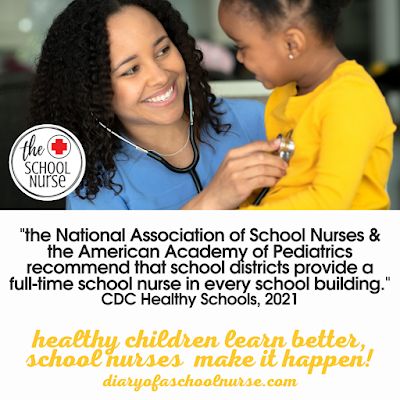
Having a full-time nurse in every school building is a recommendation by the National Association of School Nurses AND the American Academy of Pediatrics (link in the resource section below). School nurses are capable of caring for student health needs while at school. In addition, (when time allows) school nurses can: 
  • Become certified to screen vision and hearing 
  • Conduct drug testing for your high school athletic department
  • Teach coaches & other staff/students basic first aid and CPR skills
  • Support the monthly AED checks
  • Provide health education lessons and demonstrations in classrooms
  • Complete health reviews as part of the Special Education IEP team
  • Collaborate with community professionals to host school wide immunization clinics, physical exams, and dental exams and restorative dental treatment

Benefits of Hiring a Full Time School Nurse

There are countless benefits to hiring a school nurse for every school. Let's list 5 here that were pointed out by the CDC in their School Nurses Help Keep Students Healthy article:
  1. School Nurses can actually save a school district money!
  2. School Nurses may be the first health provider to identify a chronic health condition in a student.
  3. School Nurses can help students manage their chronic health conditions.
  4. School Nurses help protect the health and safety of both students and staff.
  5. School Nurses play an important role during public health crises.
Some people might find it hard to believe that hiring a school nurse could actually save their community money, but it's true. Wang et al (2014) utilized standard cost-benefit analysis methods to estimate the costs and benefits of an essential health services program compared with a scenario involving no school nursing services. They found for every dollar invested in full-time registered nurses, there was a gain of $2.20 for the society. This gain occurred because school nurses and the services they are able to provide offer a "benefit to schools, families, the health care system, and the community at large through increased student attendance, improved teacher and worker productivity, and reduced health care costs." Wang et al (2014)


PS- As you can see, the Wang et al study was completed in 2014- it would be very interested for someone to replicate this study for 2022 and compare the results! Who is looking for a research project?

PSS- Not touched on in this post is Medicaid Reimbursement for schools when nurses perform medication administration and other required and/or prescribed nursing services for students with IEPs who qualify for billing and reimbursement. I will save that detailed topic for it's very own blog post!


School Nurse Resources

CDC, 2020
CDC Healthy Schools, 2021
Illinois State Board of Education, 2014
NASN, 2015
National Center for Education Statistics, 2019
Wang et al (2014)


Check out these other popular DOASN blog posts & product links.


Tuesday, February 26, 2019

School Nurses - Does Their Compensation Match Their True Worth?

School Nurses - What are they really worth?

 + this post contains affiliate links +


Hopefully Helpful School Nurse Tip: Pay is always a hot topic within The School Nurse Fb groups. How much are you paid? Are you paid hourly or salaried?  Are you on the certified teacher contract or noncertified contract?  Do you know how to advocate for a pay increase?

School Nurses - Does Their Compensation Match Their True Worth?

If you haven't read this article yet? If not, you should!  

It had been on my to-do list since August 2018 & I'm so thankful I made time last weekend to read it.

Author, Sarah Matacale BSN RN, writes:

"School nurses have always been one of the most diverse and unique subspecialties in nursing throughout the decades. While the specific job responsibilities and pay may have changed some, the mission and purpose of the job remain constant. The National Association of School Nurses defines school nursing as " a specialized practice of nursing, that protects and promotes student health, facilitates optimal development, and advances the academic success" of its population."

School Nurses - Does Their Compensation Match Their True Worth?
full article HERE

School nursing can be very misunderstood and even hard to explain. However, in my opinion, it is the best nurse job around! Some days are more challenging than others, but I wouldn't have it any other way.   

"I was awed by what school nurses knew, the fact that they teach AND practice medicine to hundreds of students, staff, and visitors. They were so organized, knew who to call and when and what was a true emergency. At the end of the day, they knew that sometimes we just needed a hug, a listening ear, and some TLC."

Nurse Sarah says it best- read her entire article HERE

PS  Maybe all school nurses deserve a raise?

See below for more articles about promoting and supporting school nurses?


Tuesday, October 4, 2011

What Does A School Nurse Do?

School Nurses

Making a Difference One Student At a Time


Hopefully Helpful School Nurse Tip: Sometimes, it can be challenging to articulate the duties and responsibilities of school nursing. Leveraging existing resources and information can help clarify these roles. Start with this article for guidance...

Charting Nursing’s Future
A publication of the Robert Wood Johnson Foundation


I first heard about this article from School Nurse Sue Dillon-
you can read the 2010 article here.
This is a great article full of research and statistics related too.

School health services have been described as a “hidden system” of health care by Julia Graham Lear, PhD, founder of the Center for Health and Healthcare in Schools at the George Washington University School of Public Health and Health Services. Lear notes that school health services are largely unfamiliar to health policy decision makers— even though tens of thousands of counselors, nurses, psychologists, and social workers and smaller numbers of other health professionals are caring for children’s physical and emotional needs in schools.
School nurses reside at the core of this enterprise. They play diverse roles (see “What School Nurses Do,” below) and collaborate with other health professionals to serve the needs of all students. Some schools also offer expanded health services through school-based health centers staffed by nurse practitioners (see page 6).
Escalating health care costs and the failure of recent educational reform initiatives to significantly improve student performance are prompting many reformers in both these arenas to examine the connection between health and learning and to reconsider the potential of school nurses to keep children healthy, in school, and ready to learn. 
To achieve their goals, reformers will have to confront a range of challenges, including a lack of federal policy and a patchwork of state and local policies regarding school nurse staffing and practice (see pages 4–5) and the financing of school health services (see page 7). Despite these challenges, some state and local policy initiatives offer promising models (see pages 4, 5, and 7), and opportunities for greater federal support of school nursing may be gaining traction (see page 8). 

“Unlocking the potential of school nursing:
Keeping children healthy, in school, and ready to learn.”


The article also helps answer the question-

What does a school nurse do?


I’ll mention a few things school nurses do according to the article here. You can add many more too!


SCHOOL NURSES:

  1. Provide episodic care
  2. Manage chronic conditions
  3. Track communicable diseases
  4. Promote healthy behaviors
  5. Connect children with insurance and healthcare providers
  6. Handle emergency situations
  7. Handle life-threatening allergy and asthma events
  8. Respond to student's physical and emotional concerns
  9. Connect students with substance abuse treatment and mental, behavioral, and reproductive health services
  10. Screen for conditions that impair learning, such as poor vision and hearing
  11. Educate children about healthy lifestyles
  12. Ensure immunization compliance
  13. Develop health plants for students with disabilities
  14. Prepare for school wide and community emergencies
  15. Administer medication and provide first aid
  16. And so much more!
Really, there is so much more. According to a research article I recently read, there can be up to 80+ duties for a school nurse! Comment what would you add to this list?


click the images below to read these other related school nurse blog posts


Check out these other popular DOASN blog posts & product links.