Thursday, September 6, 2012

Head Lice & The School Nurse

Pediculosis and The School Nurse

+ This post contains affiliate links. +


Hopefully Helpful School Nurse Tip:  As a school nurse, it is just a matter of time before you are introduced to head lice. Having the most reliable information will help you offer accurate healthcare advice and educate your students, staff, and parents.  

 “The school nurse plays an integral role in providing education related to treatment and environmental recommendations for families affected by head lice.” (Bultas & Smith, 2022) Yet school nurses struggle with what their role in this very sensitive issue. As the leader who bridges health care and education, the registered professional school nurse… advocates for evidence-based head lice management strategies that eliminate exclusionary practices and promote positive student outcomes, including reduced absenteeism. (NASN, 2020)

What is Head Lice? 

Head lice are parasitic insects found commonly on the head, eyebrows, and eyelashes of people. Head lice have a 3 stage life cycle: egg (nits), nymph, and adult.  The adult louse lives off the blood of a human head. This louse cannot survive without blood for more 1-2 days.  
Although head lice can be a nuisance, they are not known to spread disease. They also don't discriminate and have nothing to do with the cleanliness of a family, student, or classroom.  Lice enjoy clean hair just as much as dirty hair. Lice have been found on the heads of those who live in the out in the country and those who live in the big city.
Though head lice may be a nuisance, they don't cause serious illness or carry any diseases. Head lice can be treated at home, but it's important to check with the doctor first.

What are common signs / symptoms of head lice?

  • itchy scalp
  • feeling like something is moving in the hair or on the scalp
  • trouble sleeping because lice are moving around more when it is dark
  • occasionally sores occur on the head from scratching

Important head lice facts to remember

  • Head lice cannot jump
  • Head lice cannot fly
  • Head lice cannot hop
  • Head lice can only crawl 

How are lice spread? 

  • Close contact
  • Leaning into close and/or rubbing heads together
  • Sharing combs/brushes/picks
  • Sharing head phones, hats, scarves
  • Borrowing blankets, pillows, masks (face masks and Halloween masks)
  • Laying on a surface recently in contact with someone who has lice

  • Don't screen entire classrooms or grade levels for lice
  • Don't exclude from school for nits or even live lice
  • Don't send home school wide or class wide lice notifications 

Head Lice Do's

  • Do provide privacy and head checks as needed
  • Do notify the student and parent as soon as possible if live lice or nits are found
  • Do provide accurate treatment options to the parents
  • Do allow the parents to pick up their student early to begin treatment (but don't require it)

I'd like to end this post by reminding the readers that school nursing tasks like handing out Band-Aids, ice packs, or doing lice checks may look simple on the surface, but they’re grounded in clinical judgment, evidence-based practice, and the full nursing process. In those brief encounters, school nurses are assessing, making nursing diagnoses, planning, implementing, and evaluating—all with the goal of helping students feel safe, supported, and ready to return to learning with minimal time out of class. Just as important, these everyday moments help build trusting relationships with students, showing them they’re cared for, listened to, and safe seeking help. What seems “minor” to some is often deeply meaningful to our students.

If this resonates with you—or you’ve ever felt your work was underestimated—In Defense of Band-Aids and Ice Packs is well worth the read. It captures the depth, purpose, and quiet impact behind the everyday moments of school nursing.   https://journals.sagepub.com/doi/10.1177/1942602X251379900

School Nurse Resources


 Check out these other popular DOASN blog posts & product links.


Friday, May 4, 2012

National School Nurse Day!

Did you know that May 9, 2012 is
National School Nurse Day!

+ this post contains affiliate links +


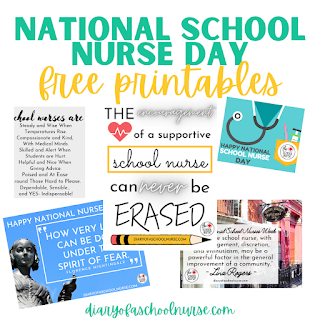
Hopefully Helpful School Nurse Tip: National School Day is a day to celebrate yourself and your hard work. It is also a great time to educate your students & staff on all of your responsibilities. Use this free digital or printable card to celebrate with your favorite school nurse co-workers and friends!

School Nurses are pleased to receive recognition on this day!

I received a card with this school nurse poem from one of my favorite school counselors- LAS! 

THANK YOU LAS, I miss you :)


Tuesday, November 1, 2011

Embrace the Frequent Flyer

FFP : Frequent Flyer Program

+this post contains affiliate links+


Helpful School Nurse Tip:  Yes, even in the school setting you will encounter frequent flyers. Learn to embrace them early on- you'll thank yourself later!

Embracing the Frequent Flyer

Embracing the “frequent flyer” is a conscious goal of mine every school year. And every year, I’m reminded of an article I read a long time ago- one that stuck with me and still shapes how I approach these visits. It was written by the original school nurse blogger (and my personal inspiration), Gerri Harvey.

Gerri had a detailed and one-of-a-kind website called School Nurse Perspectives. It was packed with everyday tips and real-world insights that spoke directly to the heart of our work. I read her posts over and over again. Though Gerri has since retired- and retired her blog- I’m lucky to still keep in touch with her through the gift of social media. Her wisdom continues to inspire me both professionally and personally.

One of Gerri’s posts that never left me was about “frequent flyers.” She reminded us that there’s always something more behind these visits. I believe that wholeheartedly.


What Gerri Said

On her blog, Gerri talked about those students we often call "frequent flyers"—the ones who show up day after day. She reminded school nurses that there’s almost always something more going on beneath the surface. I believe that too. After all these years, I’ve seen it time and time again.

Frequent Flyer Goal

With Gerri’s reminder in mind, try looking at your frequent flyers through a different lens. Instead of feeling frustrated when Student Idee shows up again, pause and ask yourself: What’s bringing them here today?

Is there an unmet need they’re trying to meet by coming to your office so often? Maybe it’s comfort, connection, or just a few quiet minutes in a safe space. When you take the time to build trust and relationships, you’ll start to uncover what they really need—and why they keep returning.

So here’s the challenge: learn to welcome those visits. You might just surprise yourself and miss them when they stop visiting so often.