Sunday, August 8, 2021

Digital Student Health History Form


Digital Health History Form for Students

+ this post contains affiliate links+


Digital Health History Form for Students

Keeping student health information up to date is an important part of school nursing practice. Knowing your students' current health conditions can help you plan for their needs, identify students who may need an Individualized Healthcare Plan (IHP) or Emergency Action Plan (EAP), and provide appropriate care throughout the school day.

A digital student health history form can provide an easy and organized way for parents and guardians to share updated health information with the school nurse.

Health History Purpose

The purpose of this digital student health history form is to provide an easier, yet formal way, for the school nurse to gather (collect data) on medical conditions for current students. Although this digital form is 100% editable, it currently offers parents a way to inform the nurse of the following:

  • Current health concerns
  • Explanation of the health concern
  • Description of how the health concerns impacts the student's school day
  • Requested accommodations the might benefit the student throughout the school day
  • Doctor contact information

As you can see, this digital health history form provides parents a chance to subjectively provide the school nurse with an overview of their child's current health conditions. The school nurse can then ask for needed / required follow up information from the student's parents and/or physician.


How To Collect A Student Health History

Have you ever had a parent call with an important health update—or had a student casually mention something you didn't previously know?

Those conversations can provide valuable information, but having updated health information documented in writing can make follow-up much easier.

A digital health history form can be shared with families at the beginning of the school year, during registration, when a student enrolls, or anytime a student's health status changes.

If you're using a Google Form, remember to review your notification and response settings so you have a reliable process for knowing when new information has been submitted.

After reviewing a response, follow up with the family as needed to:

  • Clarify health information
  • Request additional medical documentation or healthcare provider orders
  • Discuss school accommodations or supports
  • Determine whether an IHP, EAP, 504 Plan, or other documentation may be appropriate
  • Discuss how relevant health information will be communicated to appropriate school staff


Why a Health History Is Important

Accurate student health histories are important. Knowing what to do with that information is even more important.

Digital Health Records

Many schools use electronic student information systems to maintain student records. Determine how health information should be documented within your district's system and whether health conditions can be entered, tracked, and reported.

Taking the time to maintain accurate records throughout the year can make reviewing student needs—and preparing end-of-year reports—much easier.

Health Condition Lists

Many moons ago, I created Excel spreadsheets to track student health concerns because that was the best option I had!

Thankfully, today's student information systems often make this much easier. Depending on your system, you may be able to generate reports by health condition, grade level, graduation year, teacher, or other criteria.

These reports can help you understand the health needs within your school population and provide valuable data when preparing reports for administrators, supervisors, or your school board.

Individualized Healthcare Plans

Information gathered through a health history can help identify students who may need an Individualized Healthcare Plan (IHP). 

Review each student's individual needs along with your district policies, state requirements, nursing standards, and professional nursing judgment when determining appropriate health planning and documentation.

Emergency Action Plans

Students with health conditions that have the potential to become a medical emergency during the school day may require an Emergency Action Plan (EAP).

The health history can help identify students who need additional follow-up with their parent/guardian and healthcare provider to ensure appropriate emergency plans, orders, medications, and supplies are available at school.

Medication Forms

Knowing which medications a student takes can help the school nurse understand the bigger picture of the student's health.

If medication needs to be administered during school hours, follow your state requirements and district policies regarding healthcare provider orders, parent/guardian authorization, medication documentation, and administration.

Nursing Procedures

Health history information may also identify students who require nursing procedures during the school day, such as tube feedings, catheterization, suctioning, dressing changes, or other skilled nursing care.

Follow applicable state requirements, district policies, provider orders, and nursing standards when developing an appropriate plan of care for these students.

One Form Can Be the Starting Point

A student health history form doesn't replace nursing assessment or individualized follow-up. Instead, it gives the school nurse a starting point.

The information families provide can help you identify students who need additional assessment, documentation, healthcare provider orders, emergency planning, accommodations, or other school health support.

And having a consistent system for collecting that information can make the process much more manageable—especially at the beginning of a busy school year.

Looking for an easier way to collect student health information?

My editable Digital Student Health History Form can be customized for your school and shared electronically with families.


ILLINOIS SCHOOL NURSE REFERENCES:

Illinois General Assembly (Full Article)
Illinois General Assembly Codes (Child Health Examination Code, 77 Ill. Adm. Code 665) https://www.ilga.gov/.../admincode/077/07700665sections.html
Illinois State Board of Education: Health Requirements
Each state has rules listing the minimum health requirements students must meet in order to attend school. 
Try searching your state + school health requirements to locate your specific state school health requirements.

OTHER SCHOOL NURSE REFERENCES:
2015 DOASN Lillian Wald Blog Post: http://diaryofaschoolnurse.blogspot.com/search...
Complete List of Department of State Health Websites: https://www.cdc.gov/.../healthdire.../healthdepartments.html
Lillian Wald - Henry Street Settlement https://www.henrystreet.org/about/our-history/lillian-wald/
NCSL State Vaccination Policies: Requirements and Exemptions for Entering School https://www.ncsl.org/.../state-vaccination-policies...
Schools & Health: Our Nation's Investment https://www.ncbi.nlm.nih.gov/books/NBK232693/
State School Nurse Associations


Thursday, July 29, 2021

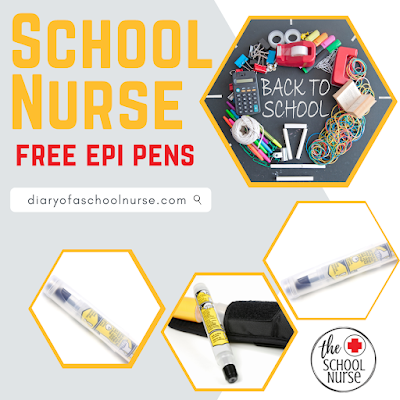
FREE EPI PENS FOR SCHOOLS!

Back To School : FREE Epi Pens

+ this post contains affiliate links +


Every school nurse should be prepared to respond to an allergic reaction—whether the student has a known allergy or not. As you prepare for a new school year, here are several important steps to help keep students safe.

Obtain (FREE) Undesignated Epinephrine

If you've been reading this blog for a while then you already know that Mylan Pharmaceuticals  & BioRidge Pharma offer 2 two packs of  FREE epi pens, replenishment epi-pens, and epi-pen trainers to qualifying schools each calendar year! I've been taking advantage of this program for many, many years and saving my school districts many, many dollars too! 

To say this is a wonderful and valuable service is an understatement. 

This is a potentially LIFE SAVING offer they continue to provide for FREE!

As with most undesignated prescription medication offers, there is required paperwork, but it is very self explanatory and easy to complete.  FYI- you will need to have your school district physician or a local physician willing to sign an order or provide a standing order.  

Having epinephrine at each school could literally save the life of a student, staff member, or visitor.  You can read all about their program & apply for your free doses HERE.  

I'm curious if there are any school nurses reading this post who have needed to use one of the free epi-pens at some point throughout a school year?  If so, please comment so the rest of us can learn from your experience. 

I'm also curious if there are any school nurses reading this post who live in a state with undesignated emergency medication laws who also have a state health department who provides the physician orders for those medications?  If so, please comment your state.   

ALLERGY EDUCATATION & PLAN

You will also want to spend some time thinking about how you will educate your staff members and maybe even the other students in your school.  The following is a list of questions that you should have answers to... these questions might even help you think of more questions that you'll need answers to.
  1. Who needs to know how and when to use an epi-pen.
  2. How will those people be taught signs/symptoms and medication administration techniques?
  3. Does your school district require a medication form or action plan?
  4. Who needs to know which students have potentially life threatening allergies?
  5. How are students with severe allergies identified? 
  6. Do students have permission to carry their own emergency medications?
  7. How will you gather more information from the parents? View this easy to use & editable digital Health History form HERE.
  8. ... and many more questions depending on your school/s and school district


Preparing Your School Team

Once you've gathered the necessary medical orders and met with the family, it's time to prepare your school team. Every school is different, but taking a few minutes to develop a plan before the first day of school can help everyone respond quickly and confidently during an allergic emergency.

Consider questions like these as you prepare for the school year:

  • Who needs to know about this student's allergy?
  • Who should be trained to recognize the signs and symptoms of an allergic reaction?
  • Who will be responsible for administering epinephrine if you're unavailable?
  • Does your district require an Allergy Action Plan, Individualized Healthcare Plan (IHP), or medication authorization form?
  • Will the student self-carry their emergency medication?
  • How will substitute teachers receive important health information?
  • What is the plan for field trips, after-school activities, and athletic events?
  • How will emergency medications be stored so they are quickly accessible?
  • How will you communicate important allergy information to staff while protecting student privacy?

Every student, school, and district is a little different, so use these questions as a starting point when developing your own systems.

Questions to Ask Parents Before School Starts

Parents are the experts on their child. While the Allergy Action Plan provides the healthcare provider's medical orders, a conversation with the parent or guardian often provides valuable information that isn't written on the form.

Consider asking questions such as:

✔ Tell me about your child's allergy. When was it first diagnosed?

✔ Has your child ever experienced anaphylaxis?

✔ Has your child ever needed an EpiPen?

✔ What symptoms usually appear first when your child is having an allergic reaction?

✔ Does your child recognize when they're beginning to have a reaction?

✔ Does your child self-carry emergency medication?

✔ Are there any classroom, cafeteria, or transportation concerns I should know about?

✔ What accommodations have worked well in previous schools?

✔ What would you like me to know before the first day of school?

Helpful Tip

The best allergy care happens when school nurses, families, students, and healthcare providers work together. Parents are the experts on their child, while the student's Allergy Action Plan provides the medical orders that guide care at school. Use your first conversation to build trust, learn about the student's individual needs, and always provide care according to the student's current healthcare provider orders.

School Staff Health Concern Notifications

Every school nurse develops communication systems that work for their building. Personally, I rely on email and Skyward to make sure those who "need to know" have the information they need. 

I always invite staff to stop by my office, call, or email with specific questions they might have too.  Teacher Tips digital cards are how I notify teachers and this is my how to guide- if it works for you that is great, if not then just take the pieces that work and switch up the rest.

Why Staff Communication Matters

As nurses, we often take our knowledge for granted and might even assume that others we work with understand or have a similar knowledge base regarding certain health conditions.


However, as school nurses, we are often viewed as the medical expert within the school setting. One of the roles of a school nurse is to educate others we work with so they understand what they need to know about certain medical conditions. Does that make sense?


Teacher Tips cards provide an opportunity to educate others within the school on a specific health condition. These teacher tips give broad information on a health condition and invite school staff to ask you for specific details as needed.


HOW TO NOTIFY TEAHCERS & STAFF


Way back when, I used to print information sheets and hand deliver them to teachers or put them inside their teacher mailbox; I’m dating myself, right?!  Now, I include these digital Teacher Tips digital health information cards within the body of an email message to teachers and/or add them as an IHP attachment in Skyward for a specific student.


EMAIL:  Since the Teacher Tips cards offer broad information, I have the option of including more student specific details within the body of the email; information staff would need to know. I can also include a copy of the 504 Plan or ask teachers to reference the 504 Plan for even more specific information. 


SKYWARD: Use Skyward to your advantage! If you have access to the Skyward Health module then consider uploading the teacher tips cards within the Health tab of Skyward Student Management.  How you wonder? Follow these steps:

  1. Open the student screen within the Health tab of the Skyward Student Management System
  2. Select IHP
  3. Then “Add File”
  4. Enter a form description and then Choose the Teacher Tips file you want to attach (download as a PDF from Google prior to attaching in Skyward)
  5. Use the Comment box to add student specific information or more detailed information you want to the teacher to be aware of.
This is an excellent communication tool and resource between you and the teachers; especially at the 6-8 or 9-12 grade levels when student schedules change mid year or without notice. Make sure you utilize the Health Condition tab in Skyward too (great information for another blog post!)

The Teachers Pay Teachers items discussed in this blog post are items I actual use- or very close variations of those items! These items are created and designed to offer consistency when working with multiple students and sometimes at multiple schools.


SCHOOL NURSE RESOURCES


HEALTH CONCERN LABELSSEVERE ALLERGYASTHMA                                              

Thursday, July 15, 2021

SUPPLIES TO STOCK THE SCHOOL NURSE'S OFFICE

The School Nurse's Supply Lists

+ this post contains affiliate links +

Helpful School Nurse Tip: Understanding your office budget and figuring out what supplies to purchase is always a challenge. Hopefully these suggestions helps you decide what items you need v. what items you want.

GENERAL OFFICE SUPPLIES

When you think about stocking your school nurse office, general office supplies might not make your first list. However, having the right office supplies to keep all of yourself organized throughout the year will actually save you time throughout the school year. You'll be amazed at the amount of paperwork and piles that go along with the paperwork! Try to come up with an office organization system that works for you. If what you're doing isn't working then give yourself permission to change and try something new until you find a system that works. 

Are you wondering what my #1 recommended general office supply is? It is the DOCUMENT SORTER!  I first shared this time saver on my Instagram account in 2019, but I had been using the device for many years prior. I purchased this one with my own money years ago and use it daily. I organized papers that I've reviewed and are ready to be filed by last name. This provides easy access to locate a paper if I need it again before I have time to actually file. This happens and before I had this document sorter I would have to thumb through stacks and stack of papers trying to find what I was looking for- can you related?  With this document sorter my "let me find that" time decreases- a lot!

Some school nurses have more than one of these time saving devices. You can sort by grade level, teacher, item (school physical, sports physical, emergency action plans, etc). Whatever works for you. The possibilities are endless. 

Purchase your very own document sorter time saver HERE.  

View other general office supplies HERE and HERE.


FIRST AID SUPPLIES

What first aid supplies should you keep in your office?  This is such a hard question to answer because it varies from state to state and from school to school.  As the school nurse, you'll want to make sure you are practicing within your scope. You'll want to find out if your school district has physician standing orders for you to follow. You'll want to read up on your school district's policies and procedures for various health scenarios. Once you have all of those questions answered, then you'll know what sort of first aid supplies are appropriate for your school nurse's office. 

You can view some basic ideas here, but again- you'll want to make sure you know what you are allowed to use and what you are not allowed to use in your specific school.


                                          Power of a Peppermint

BLOOD PRESSURE CUFFS

Should I check their blood pressure?  There may be times when you receive a doctor's order to check a blood pressure. There may be times when someone asks you to check their blood pressure. There may be an emergency when you want to check someone's blood pressure. Regardless of the situation; will you be prepared?  Do you have the proper size blood pressure cuffs to use and are they in good working order?  I personally purchased this one HERE and still use it!  I also have a large cuff available if needed; HERE.  This manual cuffs work great for me (coupled with my favorite stethoscope of course!). However, if there was an unlimited budget I would for sure order something similar to one of THESE! How about you?

STETHOSCOPES

Yes, school nurses use stethoscopes and I recommend having a good one too. My preference is Littmann. I appreciate how well the ear buds fit into my ears and how easily I can hear what I am listening to. What stethoscope is your preference?

Purchase the pictured Littmann stethoscope HERE and the colorful bracelets HERE.


THERMOMETERS

Assessing temperatures was one of the top duties during the 2020 -2021 school year. During the pandemic this responsibility was not reserved for school nurses only, it was shared with school administration, classroom teachers, and other school personnel too. Prior to the pandemic my favorite thermometer was the oral Welch Allyn SureTemp found HERE. I found this product to be accurate and very easy to use and clean. During the pandemic though, everyone seemed to make the switch to touchless forehead type thermometers, the one I used can found HERE. This one seemed accurate, but I found myself following up with an oral temp if I wanted to verify. 


ICE PACKS

I'll keep this section short because it should come as no surprise that ice packs are a staple in any school nurse office! There are a variety of ice packs available for purchase or to DIY. I prefer a countertop ice maker in my office with baggies wrapped with a paper towel. What is your preference? Also, check out this other DOASN blog post all about ice packs HERE.

MEDICATIONS &MEDICATION STATIONS

Medications! There is so much to say that I'm not sure where to start. Again, each school and school district might be a little different. First, know your nursing scope of practice within the state you are licensed and work in. Then, figure out your paperwork process for administering medications in the school setting. You can check out these digital resources on my Teachers Pay Teachers store HERE:


You'll also want to spend time defining a medication storage space in your office, spending time thinking about storage safety too. Also, do you have water available in your office for administration? Are there plenty of cups available too? These are all things to take into consideration when planning your office" medication station. Check out some traditional and unique storage supply options that might work in your office HERE.  In addition, here is a FREE training that might come in handy for you - it is editable too :)

PERIOD PRODUCTS 

Many states require the school provide period products to students for FREE. Is this a requirement in your state? In Illinois this is a requirement and you can read all about it HERE:  IL Public Act 100-0163  
I will link to several other articles with information you might find helpful:
  1. NEA Period Poverty Article
  2. P&G School Programs
  3. Edweek.org Article 
  4. FREE Teen Essentials Products- (please check availability) 

click to see how I got all of these supplies for FREE!


HYGIENE SUPPLIES

Besides period products, my school is lucky enough to never have to spend a penny on any sort of hygiene supply!  This luxury is made possible by the amazing volunteer group- Moms Who Care! If you have anyone in your community looking for a way to really make a difference then you should urge them to start their very own Moms Who Care in your school- you will not regret it. Contact them for more information :)


Thank you for reading! Stay safe & healthy!